

A Landmark Move for Inclusive Education
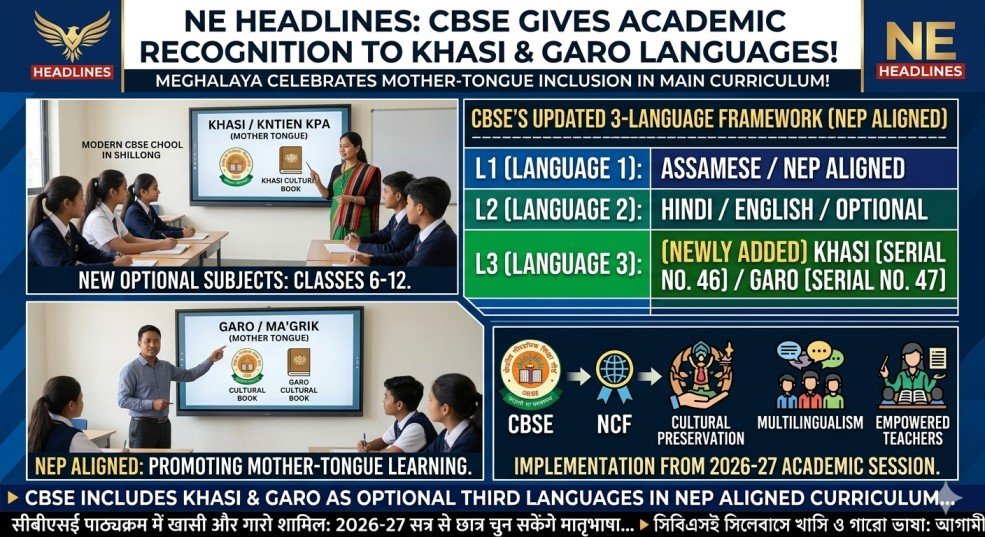
In a monumental decision for the preservation of regional heritage, the Central Board of Secondary Education (CBSE) has officially integrated the Khasi and Garo languages into its formal Scheme of Studies. The two prominent indigenous languages of Meghalaya have been assigned serial numbers 46 and 47 on the official CBSE OASIS portal. This integration allows affiliated institutions across the nation to offer them as optional subjects under the newly modified language framework starting from the 2026–27 academic session.
The rollout operates directly in sync with the core directives of the National Education Policy (NEP) and the National Curriculum Framework (NCF), both of which mandate a strong emphasis on mother-tongue instruction and multilingualism.
Resolving an Academic Disadvantage
The formal inclusion follows intense advocacy from state authorities and regional stakeholders. Previously, when the CBSE announced its updated three-language formula—which requires students to learn three separate languages beginning in Class 6—both Khasi and Garo were missing from the recognized list of 44 languages.
This omission placed local students at a severe disadvantage, forcing many to opt for non-native languages like Sanskrit or Hindi to meet the three-language criteria, even if they lacked baseline familiarity with them. Following swift interventions by the state cabinet and direct dialogue with Union Education Minister Dharmendra Pradhan, the central board amended the list to officially encompass the native tongues of the Garo and Khasi hills.
CBSE THREE-LANGUAGE MODEL (NEP ALIGNED)
├── Language 1 (R1) ── Mother Tongue / Regional Language
├── Language 2 (R2) ── National / Alternative Language
└── Language 3 (R3) ── Optional Language (Now includes Khasi [No. 46] & Garo [No. 47])
Impact on Regional Schools and Teachers
Welcoming the update, Meghalaya Chief Minister Conrad K. Sangma hailed the inclusion as a major milestone that respects and celebrates distinct tribal identity. The operational benefits are expected to expand quickly across the region:
- Empowering Local Institutions: Over 100 CBSE-affiliated schools across Meghalaya—including Kendriya Vidyalayas (KVs), Jawahar Navodaya Vidyalayas (JNVs), and private institutions—can now seamlessly adapt their curriculum to local needs.
- Securing Educator Livelihoods: The structural adoption opens formal employment avenues for specialized language teachers, standardizing regional language departments under the national board framework.
- National Validation: By placing these native systems on a central platform, the move strengthens the ongoing socio-political effort to have Khasi and Garo recognized under the Eighth Schedule of the Indian Constitution.