

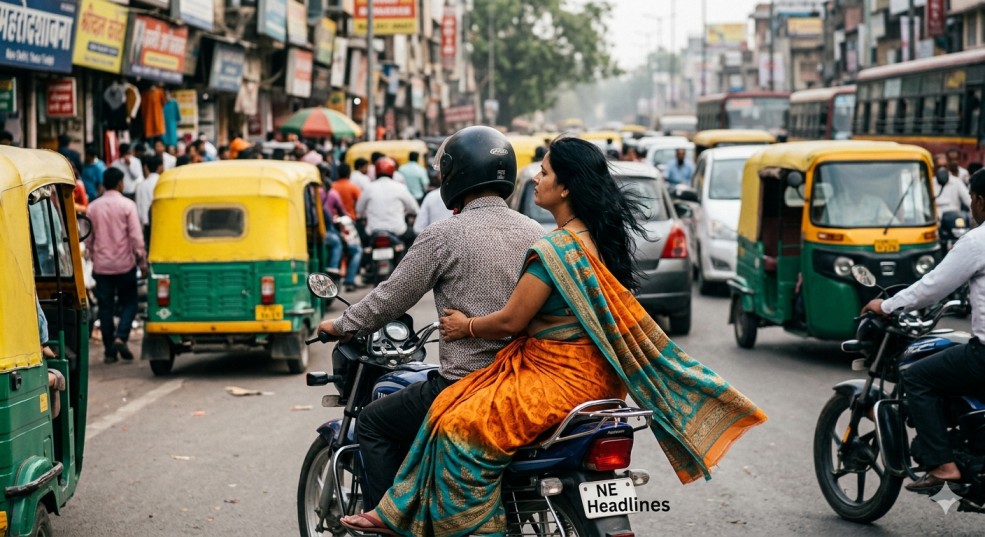
The Silent Crisis on Indian Roads
NEW DELHI — While national campaigns on road safety extensively focus on motorcycle drivers, a silent and deadly crisis is unfolding on the passenger seat. Data compiled from multiple independent medical and transport studies—including reports from the All India Institute of Medical Sciences (AIIMS) Delhi, MGM Medical College Navi Mumbai, and the Ministry of Road Transport and Highways (MoRTH)—reveals that pillion riders have become the country’s most vulnerable and neglected road users.
While helmet usage among drivers has shown gradual improvement over the years, safety compliance for passengers remains alarmingly low, leaving millions of commuters exposed to fatal head injuries daily.
The Deadly Disparity in Helmet Compliance
According to data from the AIIMS Trauma Centre, two-wheelers accounted for a staggering 53.97% of all injured patients arriving at the facility. Within this demographic, the passenger seat is statistically the most unprotected position on the vehicle.
A direct comparison of long-term behavioral trends highlights a massive safety gap:
- The Drivers: By 2022, the number of helmetless drivers involved in accidents had fallen to 15.42%.
- The Pillion Riders: The percentage of helmetless passengers sat stubbornly high at 41.12%.
Medical experts note that while the rider is slowly adopting safety habits, the passenger is systematically being left behind. This negligence directly translates to emergency room statistics, where helmetless pillion riders make up 43.8% of all trauma patients.
The Difference Between Life and Death: 100% Survival vs. Zero Protection
A pivotal 2025 study published by Magre et al. in the Asian Journal of Neurosurgery analyzed 120 pillion riders admitted with severe head injuries. The clinical data outlines a horrifying picture of what happens to an unprotected passenger during a crash:
- Brain Contusions: Found in 69.2% of cases.
- Skull Fractures: Diagnosed in 68.3% of patients.
- Subarachnoid Haemorrhage: Suffered by 59.2% of victims.
- Subdural Haemorrhage: Reported in 50% of cases.
The ultimate mortality rate among these patients was 35.8%, with every single death caused by craniocerebral (brain) injury.
However, the most definitive finding of the study lay in helmet efficacy: out of the 120 pillion riders, only 8 were wearing helmets at the time of the crash—and every single one of them survived (a 0% mortality rate). Conversely, among those riding without a helmet, more than one in three died.
Despite these clear life-saving metrics, the study noted that only 6.7% of pillion riders overall wear helmets, pointing out that while India has helmet laws on paper, the World Health Organization (WHO) enforcement score for the country stands at a meager 4 out of 10.
The Gender Risk: Why Women Facing Side-Saddle Travel are at Double the Risk
The pillion crisis takes on a severe gender imbalance in India due to traditional attire and socio-cultural habits. Approximately 73.5% of female pillion riders travel in a side-saddle position (sitting with both legs on one side of the motorcycle) rather than straddling the seat cross-saddle.
Medical data explicitly proves that the side-saddle posture creates a catastrophic risk profile when combined with the lack of a helmet:
- Cross-Saddle (Straddle) Mortality: 23.1% (Predominantly male passengers).
- Side-Saddle Mortality: 47.2% (Predominantly female passengers).
Sitting side-saddle fundamentally shifts how the human body absorbs an impact and dramatically reduces a passenger’s capability to brace or balance themselves during a sudden crash. As a result, nearly one in two women who arrived at the hospital following a side-saddle motorcycle accident did not survive. Medical researchers have urged for direct interventions to actively discourage side-saddle seating.
Road Transport Data Demands Immediate Policy Shifts
The grim reality in hospital wards mirrors the broader national data released by the Ministry of Road Transport and Highways. Two-wheeler users constitute 44.8% of all road fatalities across India, with young adults between the ages of 18 and 45—the prime demographic for female pillion commuters—representing 66.4% of those deaths. The ministry lists the neglect of safety gear, specifically the refusal to wear helmets, as a leading cause of fatal crashes.
The combined data from AIIMS, regional neurosurgery departments, and transport authorities highlights an urgent national truth: India’s passenger seats are a hazard zone. Addressing the pillion problem will require more than just passing legislation; it demands aggressive on-ground police enforcement, targeted cultural campaigns challenging the stigma around women’s helmets, and a collective behavioral shift toward passenger safety.