

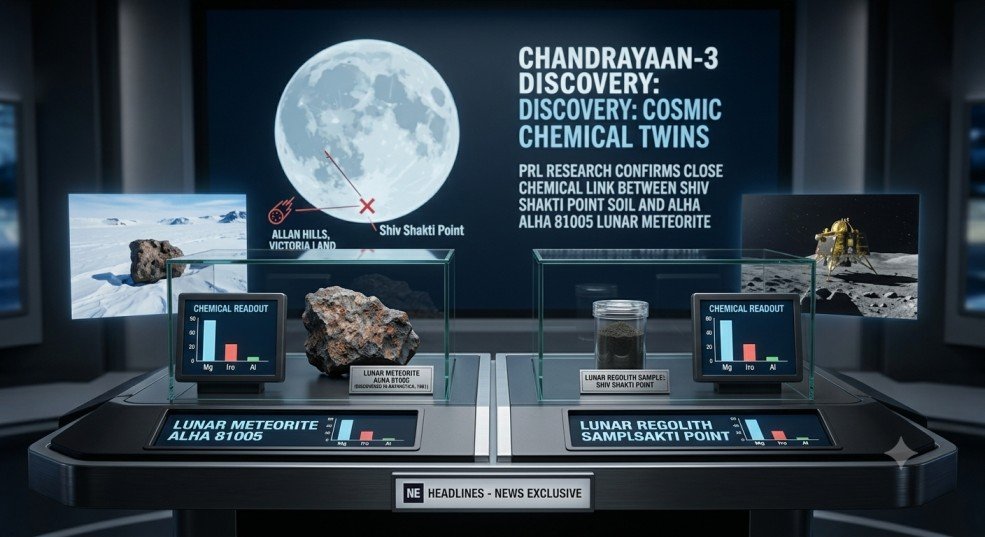
New Delhi / Ahmedabad In a monumental breakthrough for planetary science, a new study led by India’s Physical Research Laboratory (PRL) has established a direct chemical link between the lunar soil at Chandrayaan-3’s landing site—Shiv Shakti Point—and a famous lunar meteorite discovered in Antarctica over four decades ago.
According to the study published in the prestigious journal NPJ Space Exploration, the elemental composition of the Moon’s south polar highlands is an almost exact match to ALHA 81005, a meteorite recovered from Antarctica’s Allan Hills region in 1981. ALHA 81005 holds a legendary status in astronomy as the first specimen conclusively proven to have originated from the Moon.
The Footprints of Pragyan
The data that made this discovery possible was gathered by the Alpha Particle X-ray Spectrometer (APXS) aboard the Pragyan Rover, which explored the Moon’s surface after the historic August 2023 touchdown.
The APXS analysis revealed that the soil at Shiv Shakti Point features an elevated magnesium number (Mg# 70), along with unique abundances of iron and aluminum. Dwijesh Ray, lead author and PRL scientist, noted:
“The Chandrayaan-3 landing site occupies a rare compositional space between traditional ferroan anorthosite and Mg-suite lithologies (rock types), and closely resembles the lunar meteorite ALHA 81005.”
Unlocking the Moon’s Deep Secrets
To cross-verify the data, the research team—including Rishitosh K. Sinha, Santosh V. Vadawale, M. Shanmugam, and PRL Director Anil Bhardwaj—compared the Chandrayaan-3 findings against geochemical profiles of 66 feldspathic lunar meteorites sourced from across the globe (including Oman, Libya, and Africa). ALHA 81005 emerged as the undisputed closest match.
Scientists believe that this specific soil composition, rich in magnesium and olivine, indicates the presence of materials excavated from the Moon’s lower crust and upper mantle. This was likely caused billions of years ago by massive cosmic collisions, such as the creation of the nearby South Pole-Aitken (SPA) basin, which threw deep-seated molten layers onto the lunar surface.
This discovery provides groundbreaking proof for the “Lunar Magma Ocean” theory, demonstrating how space impacts rearrange and distribute deep celestial crusts.