

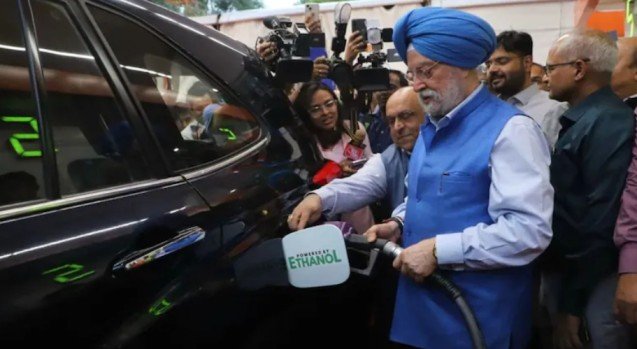
New Delhi: India’s transition toward sustainable mobility has crossed a major milestone with the official launch of E85 fuel (an 85% ethanol blend) by Union Petroleum and Natural Gas Minister Hardeep Singh Puri. Priced attractively to promote adoption, the new fuel marks a significant shift in the country’s energy landscape.
Why Has India Taken the E85 Step?
The government accelerated the E85 rollout to address three critical national challenges:
- Insulation from Volatility: Shielding Indian consumers from sudden fuel hikes caused by international crude oil fluctuations and geopolitical conflicts.
- Economic Retainment: Shifting massive foreign exchange spending from imported crude oil to domestic agricultural production. If 50% of new vehicles adopt flex-fuel, it will pump nearly ₹12,403 crore directly into the Indian farming sector.
- Massive Carbon Reduction: E85 reduces lifecycle greenhouse gas emissions by up to 61% and slashes urban particulate matter to near-zero levels due to highly efficient, complete combustion.
Where Does the Ethanol Come From & Who Supplies It?
Unlike fossil fuels, India’s fuel-grade ethanol is completely homegrown. It is distilled primarily from sugarcane juice, B-heavy molasses, damaged food grains, and maize (corn).
The primary supply network is managed by India’s top sugar and bio-energy conglomerates, who supply the fuel-grade bio-ethanol to Public Sector Oil Marketing Companies (OMCs like IOCL, HPCL, and BPCL). The leading industrial producers include:
Dhampur Bio Organics Ltd (DBO): A key manufacturer focused on integrated sugarcane processing and sustainable biofuel tech.India’s transition toward sustainable mobility has crossed a major milestone with the official launch of E85 fuel (an 85% ethanol blend) by Union Petroleum and Natural Gas Minister Hardeep Singh Puri. Priced attractively to promote adoption, the new fuel marks a significant shift in the country’s energy landscape.
Balrampur Chini Mills Ltd: One of India’s largest integrated producers, processing massive capacities in Uttar Pradesh.
E.I.D.-Parry (India) Ltd: A major distillery giant operating extensive hubs across South India (Tamil Nadu, Andhra Pradesh, and Karnataka).
- Launch Price: ₹82.12 per litre (in Delhi), making it approximately ₹20 cheaper than standard E20 petrol (priced at ₹102.12 per litre).
- Composition: A high-ethanol blend consisting of 85% ethanol (sourced from agricultural feedstocks like sugarcane and maize) and 15% conventional petrol.
- Availability: Rolled out initially at select Indian Oil (IOCL) stations across Delhi-NCR and Maharashtra. The government targets 500 operational outlets by the end of 2026 and 5,000 outlets by 2027.
E85 vs. E20 Petrol: A Quick Comparison
| Feature | Regular E20 Petrol | New E85 Fuel |
| Ethanol Content | 20% | 85% |
| Octane Rating | Lower (~91 RON) | Much Higher (~108 RON) |
| Price Point | Standard Market Price | ₹20 lower per litre |
| Tailpipe Emissions | Standard Baseline | Near-zero particulate matter; 61% lower lifecycle greenhouse gases |
| Fuel Efficiency | Baseline | 20% to 35% drop in mileage |
The Vehicle Catch & Disadvantages
While the lower price at the pump looks highly attractive, consumers must note the significant engineering limitations and disadvantages regarding vehicles:
- Strict Compatibility Warning: E85 cannot be used in standard petrol or existing E20-compliant cars and bikes. Doing so will cause severe, irreversible damage to the engine. Only designated Flex-Fuel Vehicles (FFVs) can run on it.
- Corrosion Risks: Ethanol is highly hygroscopic (it absorbs moisture from the air). In non-compatible vehicles, it corrodes steel fuel tanks, destroys rubber seals, and clogs injectors.
- The Mileage Drop: Ethanol carries roughly 34% less energy density than pure petrol. Consequently, a vehicle running on E85 will experience a 20% to 35% reduction in mileage, meaning you will fill up the tank more frequently.
- Cold Start Issues: Ethanol vaporizes poorly in cold conditions. Vehicles may experience longer cranking times or rough idling during winters or monsoons.
- Higher Upfront Vehicle Cost: Flex-fuel vehicles require specialized corrosion-resistant fuel lines, larger fuel injectors, and unique ECU sensors. This adds an estimated premium of ₹5,000–₹6,000 for bikes and ₹50,000–₹1,000,000 for cars.
- Current Vehicle Scarcity: As of now, only a few mass-market options exist in India, including the Hero Splendor+ Flex Fuel, Hero HF Deluxe Flex Fuel, and Suzuki Gixxer SF 250 FFV. Maruti Suzuki’s Wagon R Flex Fuel is currently focused on the commercial sector.