

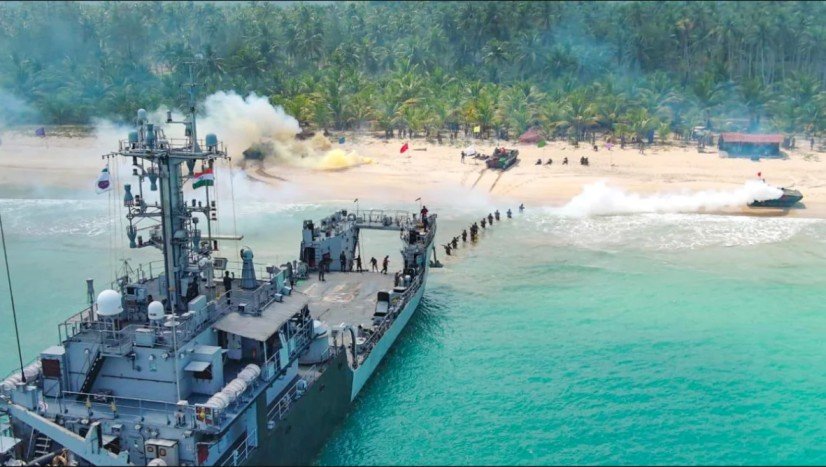
NEW DELHI — Located over 1,200 kilometers from mainland India but sitting at the literal frontlines of global trade, Great Nicobar Island is transitioning from a remote ecological paradise into the most critical pillar of New Delhi’s maritime defense policy.
As the Ministry of Home Affairs and NITI Aayog push forward with the revised ₹81,000-crore Great Nicobar Development Project, the island is being re-engineered to counter China’s naval expansionism. Western and Asian intelligence analysts alike increasingly refer to the territory as India’s “unsinkable aircraft carrier.”
India’s Watchtower Over the Strait of Malacca
The primary driver behind Great Nicobar’s rapid development is its geography. The island sits directly adjacent to the Six Degree Channel, located just 130 to 150 kilometers from the western entrance of the Strait of Malacca.
The Strait of Malacca is one of the world’s most critical maritime chokepoints, funneling nearly 94,000 merchant vessels annually. For New Delhi, transforming Great Nicobar into an advanced intelligence and military outpost weaponizes what geopolitical analysts call China’s “Malacca Dilemma.”
The Malacca Dilemma: Approximately 75% of China’s crude oil imports and nearly 30% of its global maritime trade transit this narrow 2.8-kilometer-wide corridor. If a geopolitical conflict erupts, the nation that controls the mouth of the Malacca Strait controls China’s economic lifeline.
By upgrading naval facilities alongside the existing INS Baaz military air station, India is positioning its Tri-Services Command (Andaman and Nicobar Command) to maintain round-the-clock surface and sub-surface surveillance. This gives New Delhi the direct capacity to monitor Chinese warships, submarines, and intelligence-gathering vessels entering the Indian Ocean.
The Four Pillars of the Mega-Project
The holistic master plan, executed by the Andaman and Nicobar Islands Integrated Development Corporation (ANIIDCO), spans roughly 166 square kilometers of the island. It is designed as a dual-use civilian and military ecosystem consisting of four major components:
- Galathea Bay Transshipment Terminal: A deep-sea international container port with a projected capacity of 14.2 to 16 million TEUs (Twenty-Foot Equivalent Units). Featuring a natural draft depth exceeding 20 meters, it aims to capture global shipping traffic and eliminate India’s reliance on foreign transshipment hubs like Colombo and Singapore.
- Greenfield International Airport: A dual-use air hub designed to handle peak loads of 4,000 passengers hourly, optimized for both commercial tourism and rapid military aircraft deployments.
- Gas and Solar Power Plant: A 450 MVA integrated clean energy plant built to provide self-sustaining power to the island’s new infrastructure.
- Smart Defence Township: A newly planned coastal city spreading over 16,000 hectares to house service personnel, logistics experts, and support staff.
Development Versus Conservation: The High-Stakes Debate
Despite the project’s overwhelming geopolitical necessity, it remains caught in a fierce domestic and international debate regarding its ecological footprint. Following intense legal scrutiny, the National Green Tribunal (NGT) upheld the project’s environmental clearances, citing its “paramount strategic importance” to national security. However, environmentalists warn that the ecological trade-offs are immense.
The Union Ministry of Environment, Forest and Climate Change estimates that the infrastructure layout requires the diversion of roughly 130 square kilometers of pristine, ancient tropical rainforest, necessitating the felling of nearly 9.64 lakh (964,000) trees.
Biologists warn that construction directly threatens critical habitats within Galathea Bay, a primary global nesting site for the endangered Giant Leatherback Sea Turtle. Furthermore, the project borders the ancestral foraging territories of the Shompen and Nicobarese tribes—Particularly Vulnerable Tribal Groups (PVTGs) whose isolation is legally protected under Indian law.
To counter these concerns, the Indian government has pledged strict adherence to the Shompen Policy of 2015, ensuring a buffer zone to prevent tribal displacement. Additionally, the government has mandated extensive coral reef translocation programs and designated alternative wildlife sanctuaries on neighboring islands like Little Nicobar to offset the ecological disturbance.
🗺️ Looking Ahead
The Great Nicobar Project represents a profound paradigm shift in how India handles its island territories. For decades, New Delhi treated the archipelago with defensive isolationism out of environmental caution. Today, facing an assertive Chinese “String of Pearls” strategy in the Indian Ocean, India is actively choosing to convert Great Nicobar into its premier forward operating shield.
To better understand how this ambitious project fits into the larger maritime rivalry, you can explore this visual breakdown of how India’s Great Nicobar Project Counters China near the Malacca Strait. This video provides an in-depth geopolitical analysis of the island’s location and explains how the deep-sea transshipment port challenges Beijing’s supply chain security.