

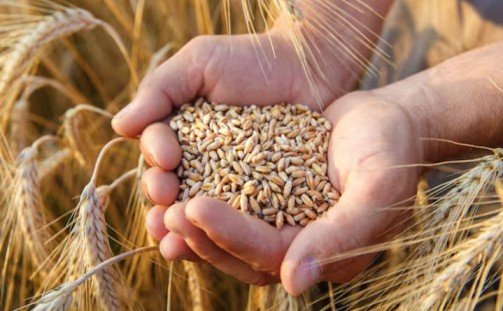
NEW DELHI — Backed by a historic harvest season, India’s government wheat procurement for the 2026–27 Rabi Marketing Season (RMS) has officially crossed 35 million tonnes (MT). According to data released by the Ministry of Consumer Affairs, Food, and Public Distribution, the current procurement marks a significant 17% surge compared to the 30 MT acquired during the previous marketing year.
The robust inflow has allowed the Food Corporation of India (FCI) and partner state agencies to comfortably outstrip the government’s upwardly revised procurement target of 34.5 MT. This development significantly fortifies the nation’s Central Pool grain reserves, pushing them well above mandatory buffer norms and solidifying domestic food security architecture.
The Production Engine: Overcoming Weather Hardships
The foundational catalyst for this year’s aggressive procurement cycle is India’s record-breaking domestic wheat output. The Ministry of Agriculture and Farmers’ Welfare, in its latest crop estimates, pinned total wheat production for the 2025–26 crop cycle at an all-time high of 120.65 MT (a 2.29% year-on-year increase from 117.94 MT).
This historic yield materialized despite significant climate disturbances. Key wheat-belt regions faced unseasonal rainfall, high-velocity winds, and severe hailstorms just weeks before harvesting. However, expanded sowing coverage—which scaled to a record 33.4 million hectares—and favorable winter temperatures provided the crop with immense structural resilience.
Market Dynamics: Mandi (wholesale market) rates across major producing regions consistently ruled below the established Minimum Support Price (MSP) of ₹2,425 per quintal. This price delta heavily incentivized farmers to pivot toward government-backed purchasing centers rather than private traders.
Regional Breakdown: State-Level Performance
The completion of the primary procurement window reflects strong state-by-state participation. While traditional agrarian powerhouses held their ground, monumental leaps in central India acted as the seasonal game-changer.
| State | 2026–27 Procurement (MT) | Previous Season Procurement (MT) | Key Trend |
| Punjab | 12.16 MT | 11.90 MT | Remains the top contributor to the Central Pool. |
| Madhya Pradesh | 10.44 MT | 7.80 MT | Recorded a massive 34% jump, clearing its state target. |
| Haryana | 8.12 MT | 7.00 MT | Steady performance outperforming its 7.2 MT target baseline. |
| Rajasthan | 2.40 MT | 1.90 MT | Noticed significant operational scale-up and higher arrivals. |
| Uttar Pradesh | 1.70 MT | 1.00 MT | Nearly doubled its state pool collection on targeted administrative revisions. |
Food Security Outlook and Central Pool Status
With the bulk of the intense April-to-June buying period drawing to a close, government reserves have received a vital cushion. Central Pool wheat stocks have collectively climbed to 51.3 million tonnes. This stands at nearly double the statutory July 1 buffer norm requirement of 27.5 MT, effectively quelling market anxieties regarding supply deficits.
However, the season has presented technical bottlenecks. Due to the unseasonal pre-harvest rain, a substantial portion of the grain suffered from “lustre loss” and localized moisture damage. To protect farmer income, the Central Government relaxed quality specifications, ultimately allowing over 67% of the total procured wheat to be accepted under relaxed parameters.
This surplus buffer provides the government with significant policy leverage. Having met its stringent commitments under the National Food Security Act (NFSA) and various welfare schemes, the administration remains in a strong position to regulate domestic price volatility, especially following the partial relaxation of the multi-year wheat export ban earlier this year.