

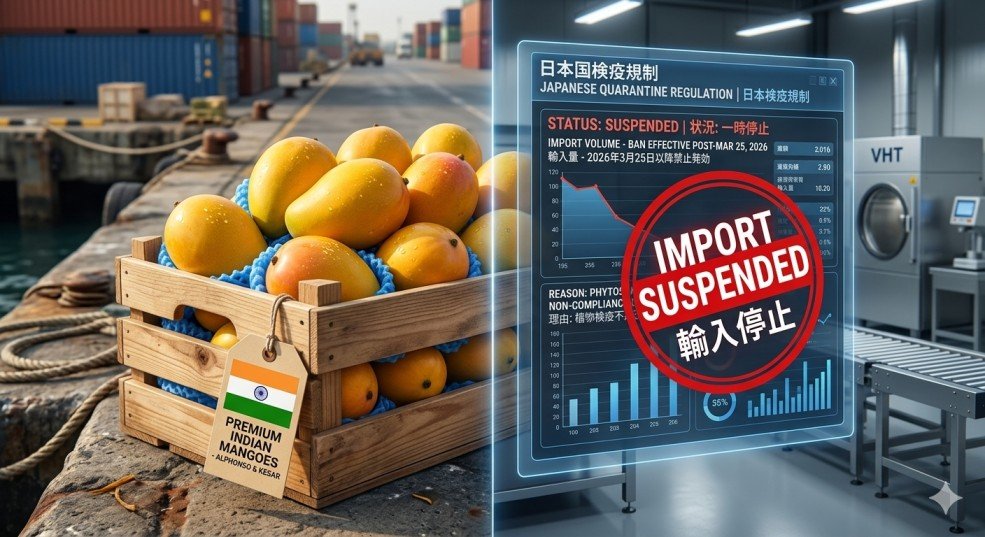
Japan’s recent decision to halt imports of premium Indian mangoes represents a significant regulatory bottleneck and a notable reputational setback for India’s high-value agricultural export sector. Triggered by phytosanitary compliance deficiencies discovered by Japan’s Yokohama Plant Protection Association during March 2026 audits, the ban completely reverses a two-decade-old trade opening established in 2006. While Japan is mathematically a niche volume market for India compared to the Middle East, the enforcement of a strict zero-tolerance policy threatens to trigger wider global scrutiny of India’s overall agricultural quality-assurance mechanisms.
Operational Breakdown & Trigger Points
According to documentation in “image_e468a6.png”, the trade suspension was enforced due to structural and functional protocol lapses:
- The Root Cause: Deficiencies were identified in the chemical and thermal cleaning protocols—specifically within the Vapour Heat Treatment (VHT), fumigation, and disinfection infrastructure used across various Indian treatment units. These facilities are legally responsible for rendering fruit entirely pest-free before packaging.
- The Specific Threat: Japanese inspectors isolated persistent risks regarding fruit flies, invasive pests capable of devastating domestic agricultural yields. Under Tokyo’s stringent agricultural protection law, any minor deviation from standard operating protocols warrants immediate border closure.
- The Mandate: Effective for all shipments carrying certificates issued after March 25, 2026, Japan’s Yokohama Plant Protection Association has formally ceased the acceptance of Indian mango varieties.
Market Dynamics & Affected Portfolios
The import suspension strikes directly at India’s highest-margin, premium export products. The targeted varieties include:
- Alphonso
- Kesar
- Langra
- Banganapalli
These specific strains command premium retail pricing and annual high demand within Japanese consumer segments. Financially, Indian exporters are experiencing a compounding squeeze: they are already weathering suppressed global demand and profound logistical bottlenecks due to the continuing geopolitical conflicts throughout West Asia.
INDIA’S GLOBAL MANGO EXPORT LANDSCAPE
Total Annual Output: ~28 Million Metric Tonnes
Global Market Share: 45% – 50% of World Volume
Strategic & Geopolitical Implications
The Reputational Risk Curve
India produces nearly 28 million metric tonnes of mangoes annually, generating a dominant $45\%$ to $50\%$ share of the entire global supply. Its single largest buyer by volume is the United Arab Emirates (UAE), followed tightly by the United Kingdom, Nepal, and the United States.
Because Japan buys a relatively low volume compared to the UAE, the direct fiscal losses to overall GDP are isolated. However, the reputational contagion risk is high. Japan represents the world’s absolute gold standard for phytosanitary testing. A public, documented failure to meet Japanese standards exposes Indian agriculture to parallel quality audits from other strict, high-income markets (e.g., the EU and the US), potentially restricting broader market access.
Historical Recurrence
This is not an isolated event; it is a structural regression. In 1986, Japan enacted an identical import ban on Indian mangoes following fruit fly infestations. It required exactly 20 years of bilateral diplomacy, technical adjustments, and regulatory overhauls for India to successfully lift that ban in 2006. Relapsing into a total import ban in 2026 indicates a breakdown in continuous oversight at treatment facilities over the last decade.
Actionable Recommendations for Export Recovery
To mitigate global trade fallout and accelerate the reversal of Tokyo’s ban, the Ministry of Agriculture and APEDA should execute the following interventions:
- Immediate Decentralized Facility Audits: Initiate a mandatory, state-backed engineering and operational audit of all Vapour Heat Treatment (VHT) plants nationwide to isolate and fix the functional lapses noted by the Japanese inspectors.
- Implement “Block-Chain” Phytosanitary Tracking: Introduce end-to-end digital batch tracking from orchards through disinfection phases to guarantee compliance transparently.
- Bilateral Technical Taskforce: Convene an immediate joint working group with the Yokohama Plant Protection Association to establish a revised, verified pre-clearance protocol, avoiding another prolonged multi-year trade freeze.