

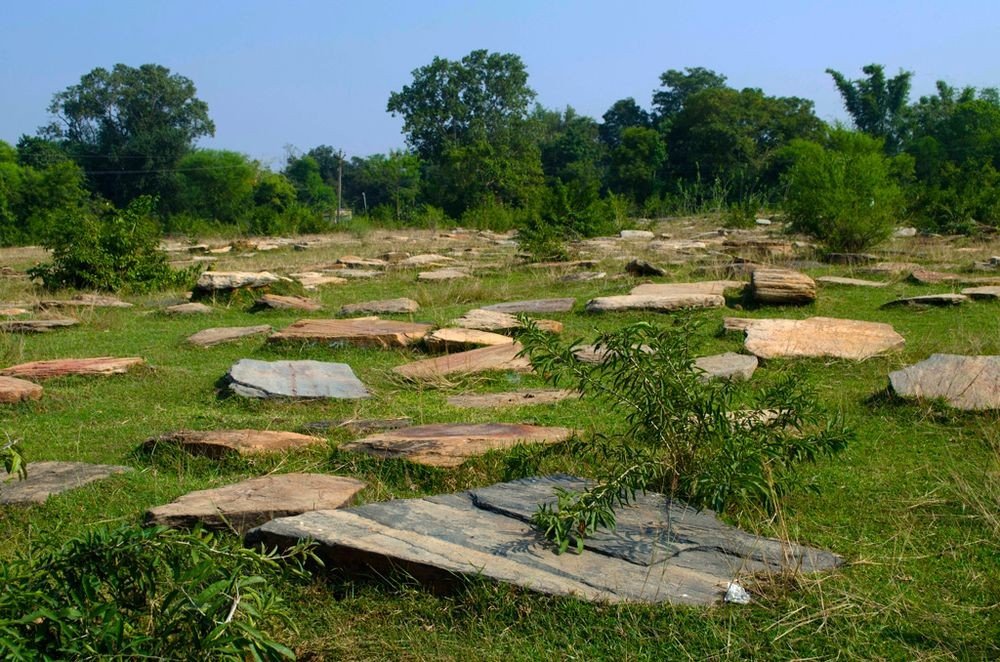
HAZARIBAGH / RANCHI: India’s ancient history is quietly being pulverized in the coal fields of Jharkhand. For three decades, Hazaribagh-based researcher and author Subhashis Das has tracked, documented, and fought for the state’s megalithic structures—prehistoric stone monuments that serve as the sociological and archaeological bedrock of the region’s Adivasi communities. Today, he warns that without immediate bureaucratic intervention, these relics will be completely erased by mining and aggressive infrastructure development.
The Battle for Chokahatu
At the heart of the preservation struggle is Chokahatu, located in the Bundu block of Ranchi district. This sprawling site is an active, ancient burial ground used uninterruptedly for centuries by the Munda tribe. Das, who first documented the site extensively in his 2009 book Sacred Stones in Indian Civilization, has spearheaded a decade-long online campaign to secure UNESCO World Heritage status for it.
The ground reality, however, remains bleak. On-ground inspections reveal a site in deep neglect, left unprotected from roaming cattle and local encroachment.
Ruined by Coal: The Tragedy of Pakri Barwadih
Why the hyper-focus on Chokahatu? Because other monumental sites are already past the point of salvation. Pakri Barwadih, a world-famous megalithic site in Hazaribagh historically used by ancient civilizations to observe equinoxes, is now on the brink of obliteration.
The culprit is large-scale industrialization. In 2016, open-cast coal mining commenced at the massive Pakri Barwadih mine. Owned by the National Thermal Power Corporation (NTPC) and sprawling over 3,000 hectares, this 15-million-tonne-per-year capacity mine operates within a lethal five-kilometer radius of the equinox site. Despite intense local protests by indigenous communities between 2017 and 2018, the heavy machinery has taken a permanent toll on the landscape.
Lost Forever
The destruction isn’t limited to public mining zones. Das recalls a heartbreaking moment when he brought visitors from England to see the Katia Murwey site—an ancient alignment he discovered near Hazaribagh over a decade ago—only to find the stone monuments had completely vanished, likely dismantled or destroyed for local construction material.
Das is currently finalizing the third edit of his fifth and final book on the subject, scheduled for release later this year. Billed as a comprehensive, wholesome history of Indian megaliths, the upcoming publication may well serve as a final archive for monuments that are rapidly disappearing from the physical world.