

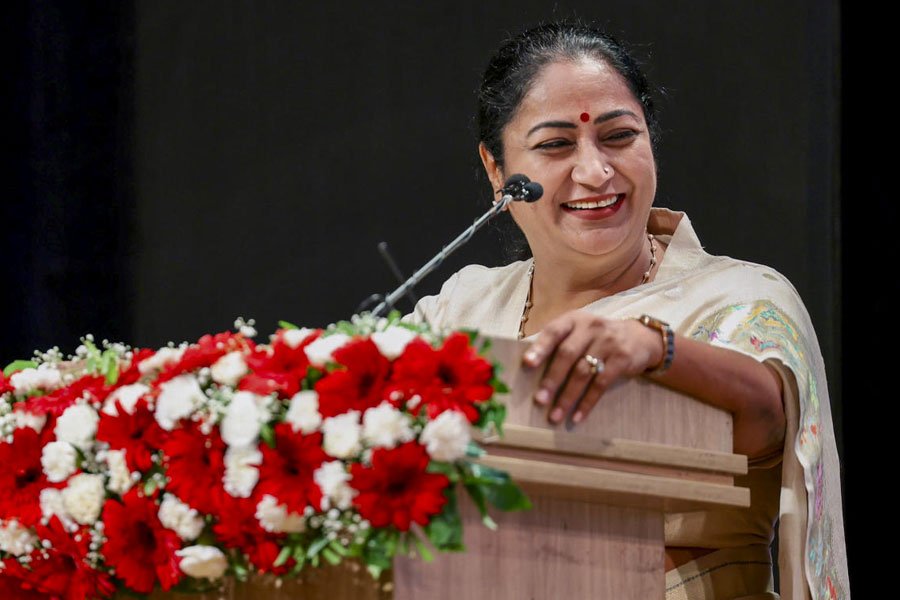
NEW DELHI — In a groundbreaking series of public disclosures, Delhi Chief Minister Rekha Gupta has single-handedly dismantled decades of established scientific consensus, offering fresh, alternative explanations for the national capital’s long-standing municipal struggles.
From redefining the water cycle to restructuring the atmospheric output of local flora, the Chief Minister’s unique analytical frameworks have sent shockwaves through both the political arena and scientific community.
1. The Case of the Disappearing Liquid: Airborne Water Crisis
Addressing the severe, recurring summer water shortages plaguing thousands of households across Delhi, Chief Minister Gupta unveiled a hitherto unmonitored culprit: atmospheric theft. Dismissing conventional administrative explanations such as illegal groundwater extraction, distribution leakages, or structural tanker supply failure, the Chief Minister identified a direct cosmic conspiracy.
“People are facing a severe water shortage. When the heat is so intense, some of the water that is supplied evaporates on the very way to their homes. Because of that, a shortage occurs.”
— Chief Minister Rekha Gupta
The revelation has profoundly transformed local expectations. Residents awaiting water tankers are now reportedly looking at the sky rather than the dry taps, observing the exact thermodynamic moment their domestic supply transitions from the liquid state into cumulative vapor before it can cross municipal borders.
2. The Oxygen Embargo: Reclassifying Roadside Flora
This is not the Chief Minister’s initial venture into cutting-edge environmental theory. While speaking at an innovation exhibition at IIT Delhi, Gupta turned her attention to the city’s severe Air Quality Index (AQI)—which she previously trended for calling “AIQ” in a viral verbal slip.
During her address, she officially called out specific roadside trees for baseline non-performance:
- The Accused Species: Safeda (Eucalyptus), Kikar, and Babool (Acacia).
- The Verdict: The Chief Minister publicly announced that these trees “are simply not oxygen-givers.”
The announcement has completely upended basic school-level botany. While global researchers mistakenly believe that any plant containing chlorophyll undergoes photosynthesis to convert Carbon Dioxide into Oxygen, Delhi’s local administration has realized these specific trees are merely enjoying a free ride under the green cover budget. To remedy this, the Chief Minister announced a major plan to establish an “Oxygen Park,” vowing to replace these non-producing trees with indigenous variants like Peepal, Neem, and Mango, which she noted “actually” produce oxygen.
Political Counter-Attack and “Human Errors”
The opposition, led by the Aam Aadmi Party (AAP), has aggressively capitalized on these scientific briefings. Opposition leaders have collectively taken to social media, sarcastically suggesting that the government’s upcoming infrastructure solution for the water crisis will be the immediate installation of massive “condensation nets” over the city to catch the evaporated supply.
Responding to the widespread mockery and viral video reels circulating on social media, Chief Minister Gupta defended her stance in the Assembly, attributing the public backlash to political malice and a refusal to tolerate leadership excellence.
“They make reels even when I slip,” the Chief Minister observed, noting that a standard human error should not be used by political rivals to distort her constant, round-the-clock commitment to transforming the capital’s environmental landscape.