

CHENNAI, TAMIL NADU:
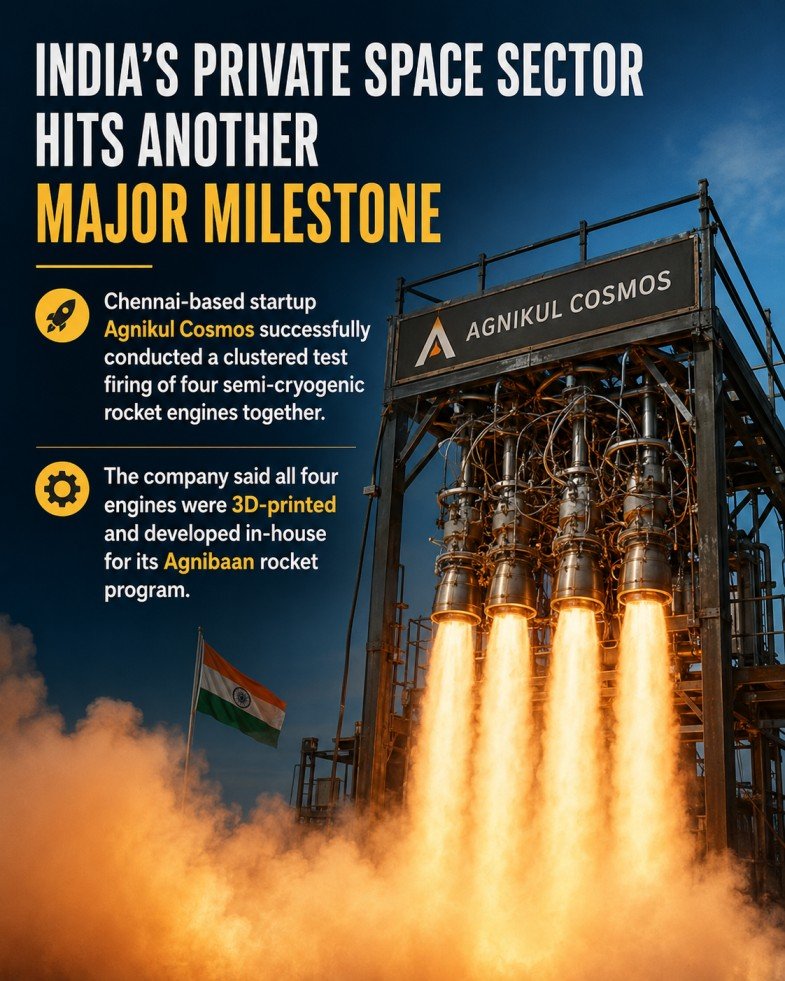
In a major technological breakthrough that firmly establishes India’s private aerospace sector on the global stage, Chennai-based spacetech startup Agnikul Cosmos has successfully conducted a synchronized cluster test-firing of four semi-cryogenic rocket engines simultaneously. The historic test, conducted on Tuesday, May 19, 2026, marks the first time such a multi-engine semi-cryogenic cluster configuration has been fired together in India, signifying a giant leap toward achieving commercial orbital launch capabilities.
All four engines used in the integrated system were entirely 3D-printed as single-piece hardware units, designed and manufactured completely in-house at the startup’s premium “Rocket Factory-1” facility located at the IIT Madras Research Park.
THE EVOLUTION OF AGNIKUL’S PROPULSION TRIALS (2024 – 2026)
2024: Single Engine Flight ──► Dec 2025: Dual-Engine Fire ──► Feb 2026: 3-Engine Trial ──► May 2026: 4-Engine Cluster Test
In real flight conditions, rockets frequently rely on multi-engine setups instead of a single massive engine to generate the necessary thrust required to carry heavier payloads into space. However, clustering introduces immense engineering challenges because every hardware component operates slightly differently under extreme thermal and pressure conditions.
To achieve a uniform start-up, a stable steady-state burn, and a flawless simultaneous shutdown across the entire system, Agnikul’s engineering team had to precisely calibrate and map:
- 8 Electric Motors running the internal propellant systems.
- 8 Fuel Pumps delivering propellants smoothly.
- 8 Speed-Control Software Algorithms operating in microsecond real-time synchronization.
Unlike traditional storable propellants or heavy turbopump engines, Agnikul utilizes an innovative electric motor-driven pump architecture paired with a semi-cryogenic fuel mix (liquid oxygen combined with refined kerosene). This significantly simplifies the rocket’s internal machinery, reducing total components while maintaining high efficiency and enabling fine engine throttling control during atmospheric ascent.
AGNIKUL’S PUMP ARCHITECTURE CONTROL MATRIX:
8 Electric Motors ◄──► 8 Fuel & Oxidizer Pumps
Controlled in real-time by:
8 Speed-Control Software Algorithms
The Advantages of Modular 3D Printing
Standard rocket engines consist of thousands of highly complex parts that require manual welding, a labor-intensive process that can easily take several months or years and leaves room for structural weak points.
By using advanced Large Format Additive Metal Manufacturing (LFAMM), Agnikul can additively print a complete, jointless engine assembly in just 7 days. This manufacturing philosophy eliminates structural joints, completely removing the risk of leaks or micro-cracks at weld points while speeding up production times by nearly 97%.
This technology serves as the core backbone of the startup’s flagship Agnibaan rocket, a customizable small-satellite launch vehicle designed to transport up to 500 kg payloads into Low Earth Orbit (LEO). Because the architecture is modular, engines can be easily added or removed from the cluster to scale up launch performance or reduce costs depending on customer needs.
A Booming Private Space Ecosystem
“We are extremely grateful to have the opportunity to be building world-class, original space technology from India, for the world,” stated Srinath Ravichandran, Co-founder and CEO of Agnikul Cosmos, acknowledging the core support received from IIT Madras, ISRO, and IN-SPACe.
The success comes on the heels of the company’s sub-orbital technology demonstration flight (Agnibaan-SOrTeD) in May 2024. Following its recent $500 million valuation and historic direct equity investments from state bodies like Tamil Nadu’s TIDCO, Agnikul is rapidly constructing heavy-duty test rigs. The startup aims to execute its first official commercial orbital satellite mission toward the end of the year, bringing India one step closer to dominating the global commercial space launch economy.