

The Judicial Reversal
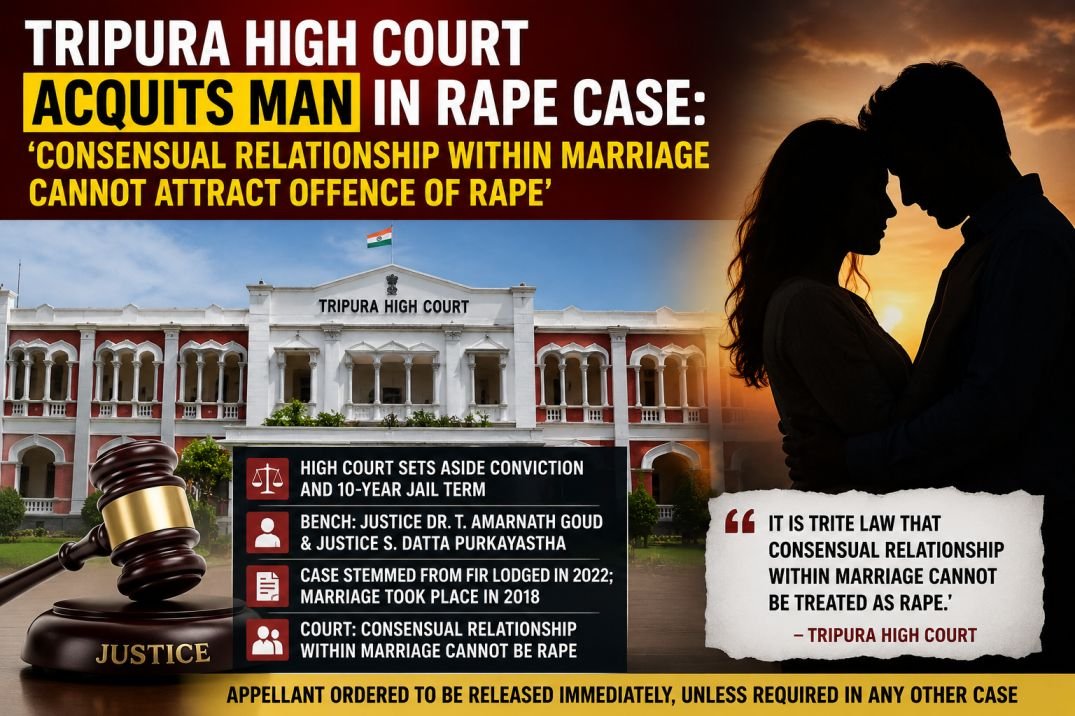
In a significant ruling regarding the legal boundaries of consent, a division bench of the Tripura High Court has overturned a trial court’s judgment that had convicted a man under Section 376(1) of the Indian Penal Code (IPC). The bench, consisting of Justice Dr. T. Amarnath Goud and Justice S. Datta Purkayastha, set aside a 10-year rigorous imprisonment sentence and a ₹1,00,000 fine previously awarded to the appellant, Sukanta Murasing, by an Additional Sessions Court in Belonia, South Tripura.
The High Court ruled that the prosecution failed to prove the charges beyond a shadow of doubt. It observed that the physical interactions between the parties were entirely voluntary, emphasizing the established legal principle that a consensual relationship within the boundaries of a legally subsisting marriage cannot be classified as rape under Section 375 of the IPC.
Background and Overlapping Disputes
The legal battle originated from a First Information Report (FIR) registered in 2022. The complainant alleged that Murasing had forced himself on her in late September 2017 against her will, subsequently promising her marriage. However, the evidentiary record revealed a highly complex timeline that contradicted claims of coercion:
- The Affection and Matrimony: The couple had shared a romantic relationship since 2013, which eventually transitioned into a physical relationship. In January 2018, they formalized their union through a notarized declaration and lived together peacefully as husband and wife for several years.
- The Social Disagreement: The friction between the two began around March 2022, when the complainant and her family requested a formal social and community wedding ceremony. When Murasing allegedly delayed or refused to organize the social wedding, the complainant approached village elders before eventually filing the criminal case.
The High Court’s Observations on Consent
During the appellate review, the High Court scrutinized the cross-examinations and medical evidence, noting that neither supported the narrative of non-consensual assault. The complainant herself admitted during the trial that she was a mature adult who understood the consequences of her choices, that she had never raised an alarm or filed immediate complaints during the initial years of their relationship, and crucially, that her marriage to Murasing remained legally valid and subsisting.
“It is trite law that a consensual relationship within marriage cannot be treated as rape, and hence the case in hand cannot come under the purview of Section 375 IPC,” the bench stated in its final order.
The Court concluded that the criminal case appeared to be the result of a domestic relationship turning sour over social disputes rather than a penal offense. Consequently, the High Court allowed the criminal appeal, quashed the trial court’s conviction order dated January 31, 2025, and directed the state authorities to release Sukanta Murasing from incarceration immediately.