

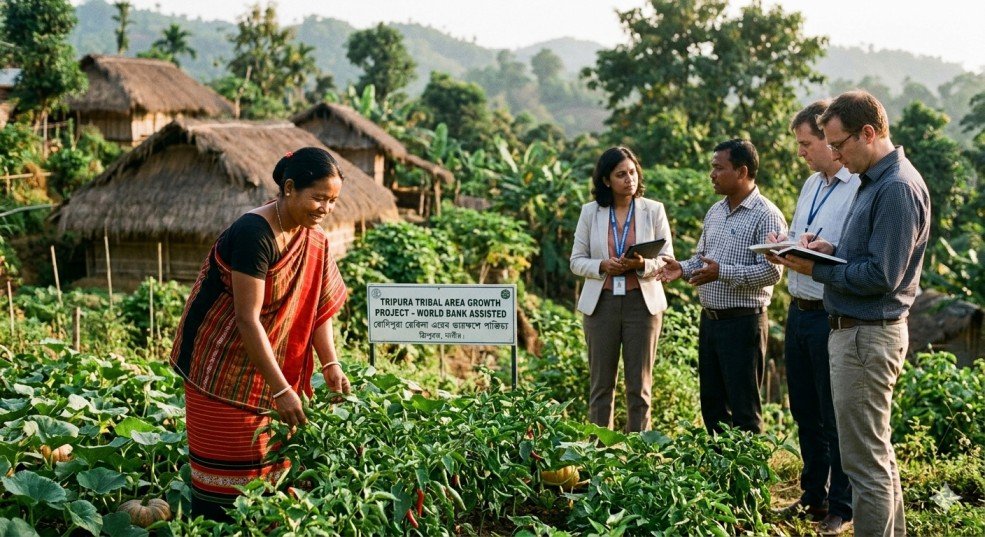
AGARTALA — The World Bank has evaluated the overall performance of the Tripura Rural Economic Growth and Service Delivery Project (TRESP) as “moderately satisfactory”. During a comprehensive mid-term review, officials noted that the initiative has achieved strategic progress across multiple developmental sectors.
Launched in 2024, TRESP is a six-year project specifically designed to upgrade rural livelihoods, improve public service delivery, and generate new economic opportunities within the tribal regions of Tripura.
Review Mission and Implementation Progress
The assessment was finalized during the project’s sixth Implementation Support Mission (ISM) and Mid-Term Review (MTR) in Agartala, featuring collaborative meetings between World Bank representatives and state government officials. World Bank Task Team Leader Priti Kumar highlighted that the project has registered significant progress across various sectors over the last six months.
The evaluation process included multiple high-level briefings:
- Initial Kick-Off Meeting: Chaired by Tribal Welfare Department Secretary K Sashikumar at Pragya Bhavan, project authorities presented progress updates spanning key project components, including livelihoods, roads, education, infrastructure, agriculture, fisheries, and animal resources development.
- High-Level Secretariat Review: A subsequent meeting chaired by Chief Secretary J K Sinha at the State Secretariat analyzed execution challenges and outlined measures to meet targets within the designated timeframe. Sinha noted that while the Model Code of Conduct and adverse weather conditions had temporarily slowed implementation in certain areas, project activities are expected to quickly gather pace. He reiterated the state’s full commitment to resolving fund, logistics, infrastructure, and manpower requirements.
Key Livelihood Achievements and Milestones
According to official briefs, the mid-term evaluation brought forward several notable milestones regarding rural mobilization and economic support:
- Financial Backing: Working capital support has now been successfully extended to nearly 60% of all eligible groups.
- Institutional Strengthening: Local community institutions have been progressively reinforced to better manage resources.
- Market Integration: The project has successfully activated producer groups for livelihood generation while promoting product aggregation and collective marketing.
To sustain this implementation momentum, the World Bank team emphasized that the state must focus on building stronger monitoring systems, ensuring the timely execution of planned activities, and effectively deploying field-level human resources.
Advancing Climate-Resilient Agriculture and Village Planning
The delegation also held a focused review session with Agriculture and Farmers’ Welfare Department Secretary Apurba Roy and representatives from the State Institute of Public Administration and Rural Development (SIPARD).
The agricultural discussions concentrated heavily on long-term sustainability and value addition:
- Value Chain Strengthening: Plans were outlined to enhance commodity-based value chains using market assessments, commodity mapping, and cluster-based planning.
- Extension and Training: The review emphasized upgrading agricultural extension services via technical support agencies, building the capacity of community resource persons, and scaling up the training-of-trainers framework.
- Climate Resilience: The World Bank team stressed the necessity of adopting climate-resilient agricultural practices, maintaining rigorous quality monitoring, increasing field supervision, and converging operations with solar-powered and sustainable farming initiatives.
A major highlight of the mission was the evaluation of the Village Development Plan (VDP) initiative, which is currently being executed by SIPARD. The World Bank praised the participatory planning methodology utilized to draft development blueprints across various tribal villages.
To further optimize this program, the review suggested that future VDPs incorporate granular, household-level data regarding landholdings, health, education, livelihood assets, and access to basic services. This addition is intended to facilitate highly accurate, evidence-based planning and enable the smooth convergence of various government welfare schemes.