

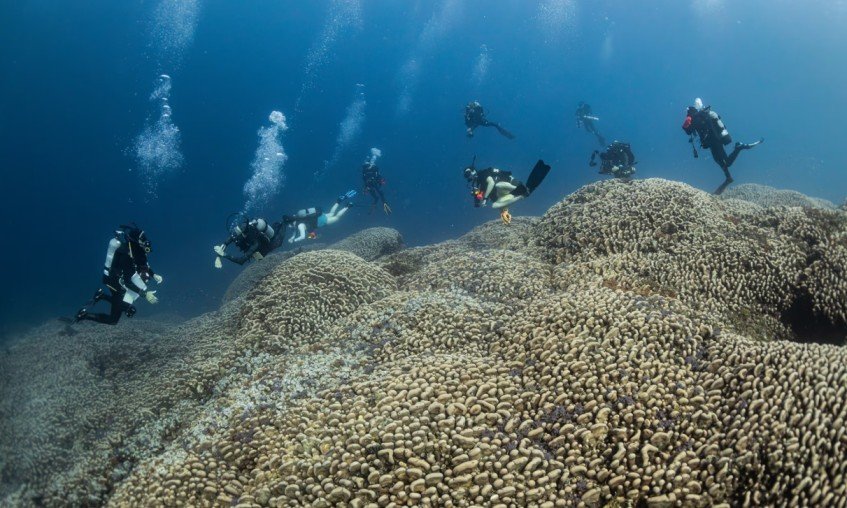
KAVARATTI — Researchers in India have documented a massive, giant coral colony near Kadmat Island in Lakshadweep. The extraordinary underwater formation is spread across an estimated area of 4,250 square meters.
Belonging to the Pavona clavus species, the formation is known locally as the “Potato Patch”. Marine scientists note that this discovery could potentially be among the largest known living coral colonies ever recorded anywhere in the world.
Centennial Longevity and Health Status
Preliminary growth-rate estimates conducted by the team suggest that the colony may be between 700 and 1,800 years old. However, researchers have emphasized that this initial estimation still requires formal scientific dating to be fully confirmed.
A comprehensive survey of the “Potato Patch” revealed promising data regarding its survival:
- The study found that 58.47% of the total coral tissue was fully alive.
- This percentage indicates a relatively healthy state for the colony.
- The colony has maintained this health despite enduring repeated marine heatwaves, severe bleaching events, and regional cyclones.
Implications for Marine Science
Scientists state that the documentation of this giant colony is a major milestone for marine ecology. The finding is expected to significantly advance global research on coral longevity, reef resilience, climate adaptation, and marine conservation strategies across the Indian Ocean.