

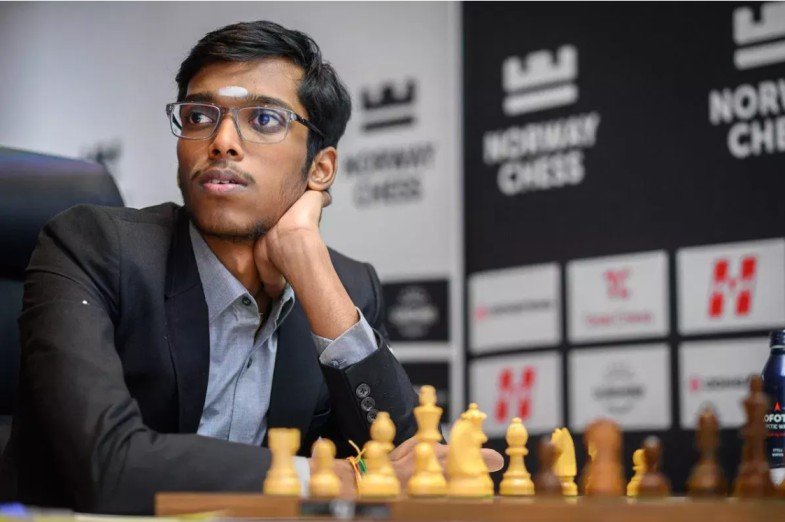
Indian Grandmaster R Praggnanandhaa completes a miraculous comeback in Oslo, winning four consecutive classical games—including against Carlsen and Gukesh—to win Norway Chess 2026.
OSLO — Indian Grandmaster Rameshbabu Praggnanandhaa has scripted a historic chapter in international chess. By defeating Germany’s Vincent Keymer in the high-stakes final round, the 20-year-old prodigy from Chennai officially became the first Indian champion in the tournament’s 14-year history.
The victory capped off a remarkable, adrenaline-fueled final week in Oslo, vaulting Praggnanandhaa to the top of the leaderboard with 18 points. He clinched the prestigious title just one point ahead of American GM Wesley So.
From Last Place to a Miraculous Four-Game Win Streak
Praggnanandhaa’s path to the trophy was nothing short of a sporting miracle. The elite double round-robin tournament—numerically graded as one of the strongest fields of the year—started out roughly for the young Indian.
After suffering two consecutive classical defeats in rounds five and six, Praggnanandhaa found himself languishing at the bottom of the scoreboard, a seemingly insurmountable 5.5 points behind the tournament leader, Wesley So.
What followed will go down as one of the greatest late-stage surges in super-tournament history. Needing clear wins to stand a chance, Praggnanandhaa unleashed a stunning, four-game classical win streak to close out the event:
- Round 7: Defeated former World Blitz Champion Alireza Firouzja.
- Round 8: Toppled world number one and local hero Magnus Carlsen.
- Round 9: Outmaneuvered fellow countryman and reigning World Championship Challenger D Gukesh.
- Round 10: Defeated an unbeaten Vincent Keymer on-demand with the white pieces.
The Crucial Final Round Decider
Heading into the tenth and final round, Praggnanandhaa trailed Wesley So by half a point, meaning a draw would likely hand the American the tournament victory. Armed with the white pieces against Keymer, Praggnanandhaa pushed intensely for a double-edged complication.
The critical moment came on move 30. Keymer made a fatal positional blunder with 30…h5, opening up a tactical avenue that the Indian grandmaster quickly capitalized on. Praggnanandhaa calculated a forcing combination starting with 31.Rb8+! Kh7 32.Nef3! to secure a decisive material advantage.
Though his conversion of the endgame was clinically precise, Praggnanandhaa later admitted to reporters that the immense pressure had taken its toll: “I couldn’t think anymore—I was just making moves with my hand!”
With Praggnanandhaa securing the full 3 points for a classical win, the spotlight shifted to Wesley So. So was held to a classical draw by Alireza Firouzja and only managed to win the subsequent Armageddon tiebreak, leaving him at 17 points and handing the outright championship to India.
Final Standings and Global Implications
The tournament’s closing round also saw Magnus Carlsen secure a consolation victory over a struggling D Gukesh, pushing Carlsen up to a fourth-place finish, while Firouzja secured third.
| Rank | Player | Points | Final Status |
| 🥇 1 | R Praggnanandhaa (IND) | 18.0 | Tournament Champion |
| 🥈 2 | Wesley So (USA) | 17.0 | Runner-up |
| 🥉 3 | Alireza Firouzja (FRA) | 15.5 | Third Place |
| ♟️ 4 | Magnus Carlsen (NOR) | – | Fourth Place |
This historic victory marks a thunderous redemption for Praggnanandhaa following a turbulent 10-month period where his live rating had slipped from the high 2780s down to 2730. Gaining 15.2 rating points from this tournament alone, he has surged back above the 2750 threshold and risen to 11th on the live global rating list.
As he exited the Oslo venue, Praggnanandhaa was swarmed by a massive crowd of cheering chess fans. Reflecting on the breakthrough, the champion smiled and noted that he was not thinking about the next World Championship Candidates cycle just yet: “Something just didn’t go my way at all [recently]… right now, I just want to enjoy my games.”