

The Multi-Business Scrutiny
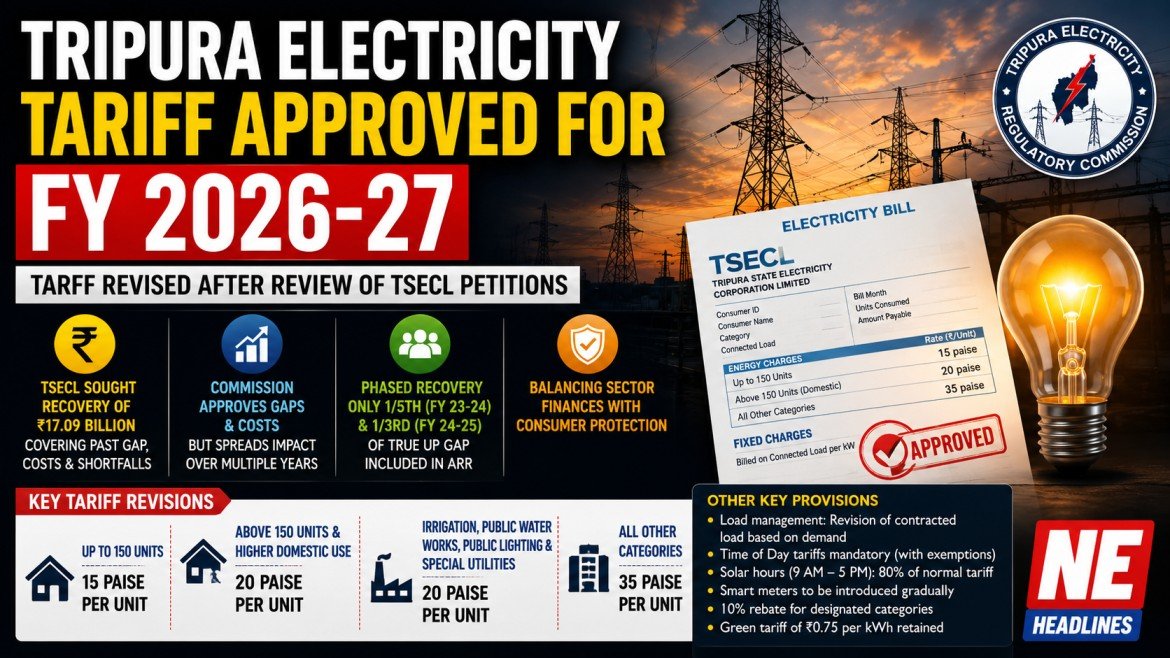
In a major regulatory development for the state’s energy infrastructure, the Tripura Electricity Regulatory Commission (TERC) officially issued its tariff order for the financial year FY 2026–27. The order, finalized after a rigorous process of public hearings and advisory committee reviews, came as a direct response to a Multi-Year Tariff (MYT) petition submitted by the Tripura State Electricity Corporation Limited (TSECL).
Because TSECL operates as an integrated utility, the Commission meticulously audited petitions across three distinct operational segments: generation, transmission, and distribution. The final statutory order balanced the financial sustainability of the state utility against consumer affordability, avoiding a massive price shock for local households.
Financial Mechanics: True-Up and Deficit Phasing
A key component of the regulatory process was the financial “truing up” for FY 2024–25, where TERC cross-referenced the actual operational expenditures and revenues of the utility against prior projections.
- The Staggering Deficit: TSECL originally projected a massive, accumulated revenue gap of ₹17.09 billion, driven by rising natural gas prices, inflationary pressures, and escalated power purchase bills.
- The Rejected 43% Hike: To bridge this gap immediately, TSECL requested a standalone Aggregate Revenue Requirement (ARR) of ₹21.64 billion, which would have translated into a crippling 43% tariff increase alongside the introduction of a premium “Regulatory Surcharge.”
- The Phased Compromise: Invoking Supreme Court and APTEL guidelines regarding the systematic liquidation of regulatory assets, TERC flatly rejected the extra surcharge. Instead, the Commission trimmed the requested operational figures, approved a ₹770 million government subsidy, factored in ₹1.50 billion in carrying costs, and capped the final approved tariff recovery at ₹12.75 billion. Past true-up gaps from FY 2024–25 are instead being liquidated gradually over a multi-year cycle to protect the public.
Direct Impact on Consumer Wallets
The revised base tariff structure features highly moderate energy charge adjustments rather than a steep shock, varying by consumption brackets:
| Consumer Category | Energy Charge Hike (Per Unit) |
| Domestic Consumers (Up to 150 units) | Increase of ₹0.15 / kWh |
| Domestic (>150 units), Irrigation, Public Lighting | Increase of ₹0.20 / kWh |
| All Other Categories (Commercial & Industrial) | Increase of ₹0.35 / kWh |
The Commission retained fixed charges based on connected load per kilowatt ($kW$) for domestic single-phase and select commercial users rather than charging a flat fee per connection.
Mandatory Time-of-Day (ToD) Grid Reforms
The structural standout of the FY 2026–27 order is the mandatory transition to a Time-of-Day (ToD) tariff system for almost all major consumer categories, excluding small domestic households and agricultural irrigation.
- Solar Peak Discount (9 AM – 5 PM): To incentivize the consumption of clean energy when grid solar output is at its highest, power used during these hours will be discounted and billed at just 80% of the normal base rate.
- Evening Peak Surcharge (5 PM – 10 PM): Conversely, power consumption during high-stress evening peak hours will attract higher, premium rates to lower the strain on grid transmission.
The rollout of mandatory smart meters is being fast-tracked across the state to handle this real-time variable billing accurately.
Promoting Green Energy and Social Rebates
While modernizing the grid, TERC protected existing progress-driven schemes:
- Green Tariff Retained: The premium green energy option remains fixed at ₹0.75 / kWh for eco-conscious consumers opting out of fossil-fuel-reliant power sources.
- 10% Priority Rebates Continued: Special 10% concessions on energy bills remain active for remote homestays, information technology (IT/ITES) parks, medical clinics, and commercial networks run exclusively by registered Women Self-Help Groups (SHGs).
Strict Operational Directives for TSECL
To force internal accountability, TERC paired its revenue approvals with aggressive performance targets. Notably, while the utility recorded a massive 27.56% distribution loss in FY 2024–25, the Commission has capped the approved loss target for the current fiscal cycle at a strict 18.30%, forcing TSECL to swallow the costs of any excess power theft or inefficiency.
Furthermore, the utility must fully separate its generation and transmission accounting books, execute automated consumer load-upgrades if contracted maximum limits are breached for three consecutive months, and finish full-scale regional feeder energy audits within six months.