

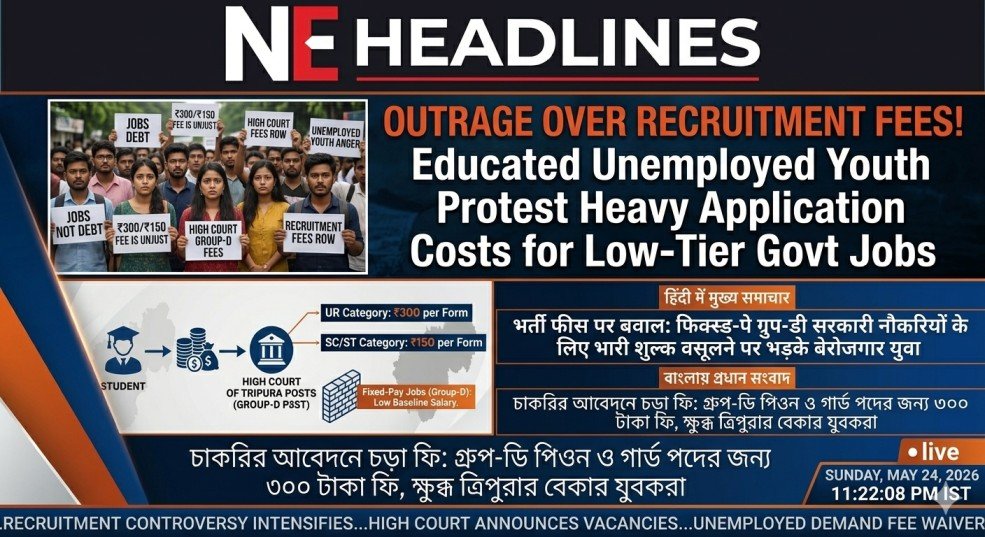
The Core Controversy
A major wave of discontent has rippled through the educated, unemployed youth of Tripura following a fresh recruitment drive initiated by the High Court of Tripura. At the center of the dispute are the substantial application fees levied on candidates vying for basic, entry-level Group-D positions—such as Peons, Orderlies, and Guards. Job seekers and student welfare activists are questioning the ethics of demanding hundreds of rupees from economically vulnerable applicants, especially for lower-tier roles that offer basic, fixed pay packages.
The notification outlines a total of 69 vacancies for Group-D posts across the state’s judicial establishment on a strictly contractual, fixed-pay matrix.
The Financial Breakdown of Application Fees
The cost structure announced in the official circular has been criticized by various applicant groups as highly disproportionate compared to the baseline salary tier of the advertised jobs:
- General / Unreserved (UR) Category: Required to deposit an application fee of ₹300 per registration.
- Scheduled Caste (SC) & Scheduled Tribe (ST) Categories: Eligible for a concession but must still pay a non-refundable fee of ₹150.
The primary grievance stem from the fact that these 69 positions are designated on a fixed monthly pay structure (roughly starting around ₹12,000 per month). Aspirants argue that for individuals who are already struggling under prolonged unemployment, pooling together continuous non-refundable testing fees across dozens of different department notifications is becoming financially unsustainable.
Wider Impact on Job Seekers
The agitation surfaces at a time when administrative hiring protocols in the state are under intense public and legal scrutiny. Activists point out that while corporate application systems or central agencies have the infrastructure to justify high overhead costs, regional job seekers should not be viewed as a source of revenue collection through test applications.
Many young job seekers are demanding that either the state government or the judicial administrative board introduce full fee waivers or nominal, token registration costs for all Class IV and Group-D categories to keep public sector employment genuinely accessible to the poorest sections of society.