

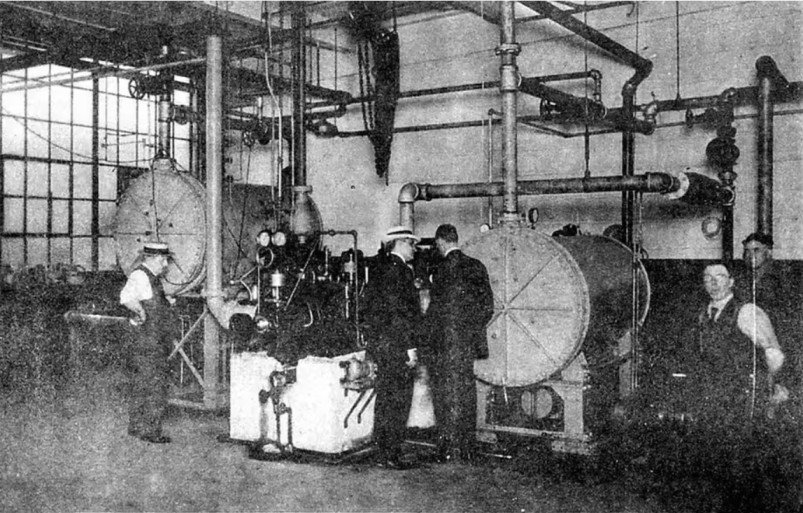
Before mechanical engineering tamed indoor climates, humanity relied on primitive thermodynamics. Wealthy Romans ran cool aqueduct water through their villa walls. In medieval Persia, engineers constructed badgirs (wind catchers) to funnel desert breezes underground over cold water pools. But none of these ancient systems actually altered the air’s moisture content—the true enemy of summer heat.
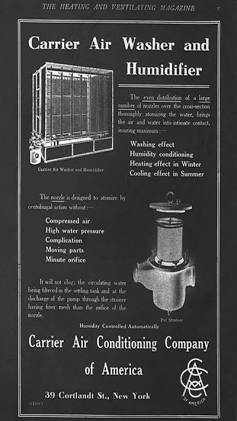
1902: The Industrial Breakthrough
The transition to modern air conditioning occurred in 1902 at the Sackett-Wilhelms Lithographing & Publishing Company in Brooklyn, New York. High summer humidity was wreaking havoc on their multi-color printing processes. Paper expands and contracts depending on atmospheric moisture; when the paper changed size between ink applications, colors misaligned, ruining entire production runs.
A 25-year-old experimental engineer named Willis Haviland Carrier solved this. Instead of trying to cool the air, he focused on manipulating moisture. He designed a system that used a heating engine running backward: it forced air over pipes filled with cool water. As the warm air hit the cold pipes, the moisture in the air condensed onto the metal and dripped away, exactly like water droplets forming on a cold glass of iced tea.
By pulling water out of the room, Carrier achieved two things:
- He stabilized the relative humidity to precisely 55%.
- He lowered the room temperature as a secondary side effect.
Carrier quickly realized the broader applications of his invention. He founded the Carrier Air Conditioning Company of America, selling units exclusively to industrial clients. Throughout the 1910s, early AC systems were deployed to stabilize manufacturing environments for textiles, flour mills, chewing gum factories, and gunpowder storage facilities where humidity control was a matter of life and death.
1920s: The Shift to Human Comfort
Early industrial AC units were massive, expensive, and utilized highly dangerous, volatile chemicals as refrigerants—namely toxic ammonia, sulfur dioxide, and flammable propane. Because a leak could be fatal, these systems were deemed entirely unfit for public spaces.
The breakthrough for human comfort arrived in 1922 when Carrier invented the Centrifugal Refrigeration Compressor. This machine was smaller, far more reliable, and utilized a safer, non-toxic coolant called Dielene.
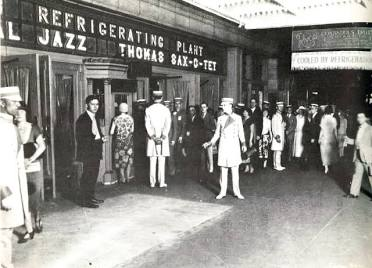
To market this expensive new machine, Carrier targeted the entertainment industry. Movie theaters during the 1920s routinely shut down during July and August because the combined body heat of hundreds of patrons turned auditoriums into suffocating ovens.
On Memorial Day in 1925, New York City’s Rivoli Theater debuted Carrier’s centrifugal chiller. The theater ran advertisements promising “Cool, Clean, Comfort” and ice-cold indoor air. The experiment was an instant sensation. Droves of citizens paid ticket prices not to see the films, but to escape the blistering summer heat. This wildly successful marketing campaign gave rise to the American tradition of the “summer blockbuster.” Soon, luxury department stores, banks, and the US Congress installed systems.
1930s–1950s: Miniaturization and the Residential Boom
While public buildings were cool, the average home remained a sweatbox. In 1928, Thomas Midgley Jr. synthesized Freon (chlorofluorocarbons or CFCs). Freon was non-flammable, completely non-toxic to humans, and incredibly efficient at heat exchange.
With a safe refrigerant now available, engineers raced to downsize the mechanical components. In 1931, inventors H.H. Schultz and J.Q. Sherman patented the first individual window-mounted air conditioning unit. However, because they cost between $10,000 to $50,000 in today’s money, they remained a luxury for the ultra-wealthy.
The true democratization of cool air happened after World War II. Post-war manufacturing efficiency skyrocketed, and by 1947, mass-produced, affordable window units hit the market. By 1953, annual sales of home air conditioners surpassed one million units across the United States.
How AC Reshaped Global Demographics
The evolution of air conditioning did more than provide comfort—it fundamentally altered human geography and architecture:
- Geographic Migration: Before AC, the southern and western regions of the United States (the Sun Belt) were mostly agrarian and sparsely populated because summers were brutal. The widespread adoption of residential AC allowed explosive population booms in cities like Houston, Phoenix, Las Vegas, and Miami. It turned them into economic powerhouses.
- Architectural Overhaul: For centuries, homes were designed with high ceilings, deep wrap-around porches, transoms, and brick structures to naturally vent heat. AC completely erased these requirements. It paved the way for low-ceiling glass skyscrapers and uniform suburban tract housing.
- Global Urbanization: This technology eventually laid the foundation for the rapid modernization of equatorial megacities worldwide, from Singapore and Hong Kong to Dubai and Mumbai.