
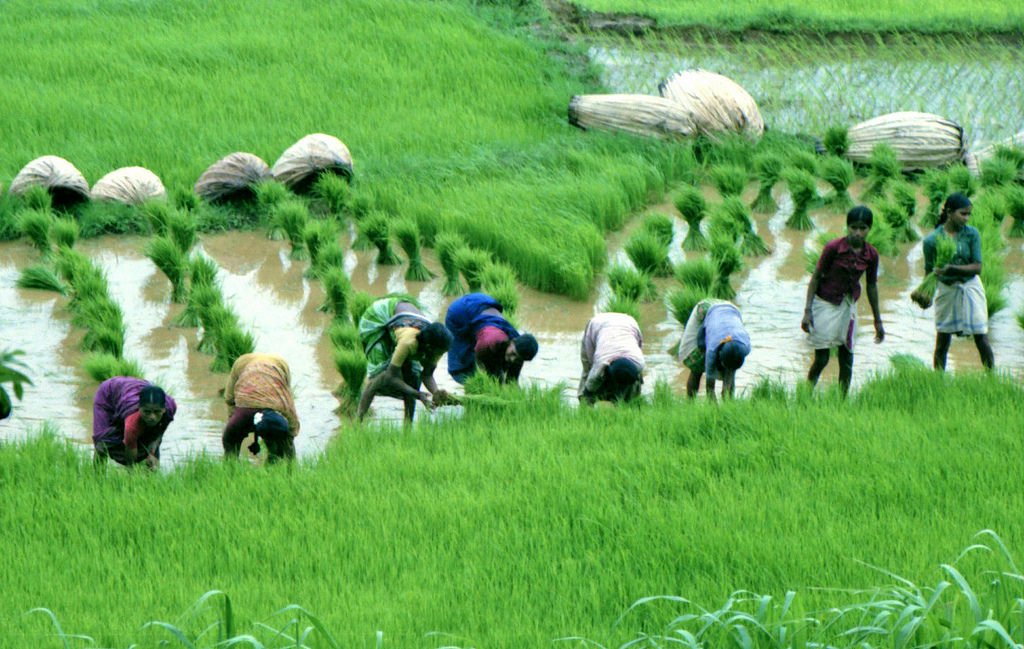
NEW DELHI — In a historic shift in global agriculture, India has officially surpassed China to become the world’s largest producer of rice. The milestone comes at a critical juncture as the central government rolls out an aggressive, nationwide agricultural contingency plan to safeguard the crucial upcoming kharif sowing season against erratic monsoons and mounting climate-related threats.
According to the Ministry of Agriculture’s third advance estimates, India’s rice production for the 2025–26 crop year is projected to scale an all-time high of 154.02 million tonnes (mt), up steadily from the previous year’s record of 150.18 mt. In contrast, China’s production has hovered around 145.28 mt, solidifying India’s position at the top of global charts.
The Production Breakdown
India now commands roughly 28% of total global rice production and dominates the international trade arena, accounting for over 40% of global rice exports.
According to data from the Economic Survey, the domestic surge is fueled heavily by three key states:
| Rank | State | Output (approx.) | Share of National Output |
| 1 | Uttar Pradesh | 20.76 mt | ~13.82% |
| 2 | Telangana | 17.45 mt | ~11.62% |
| 3 | West Bengal | 16.02 mt | ~10.66% |
Punjab and Haryana continue to serve as the high-yield hubs driving premium, aromatic long-grain Basmati exports to global markets.
Mitigating Climate Risks: The Kharif Strategy
Despite the celebratory numbers, Agriculture Minister Shivraj Singh Chouhan emphasized that the government is not dropping its guard. As farmers prepare to flip the switch on the kharif sowing window (June–July), the meteorology desk warns of rising El Niño conditions that could spark an 11-year low in seasonal rainfall.
“Our progress in high-yielding seed development has unlocked historic production levels, but climate adaptation remains our primary defensive line.”
— Shivraj Singh Chouhan, Union Agriculture Minister
To counter a potentially weak monsoon, the government’s newly unveiled contingency plan focuses on several defensive agricultural measures:
- Climate-Resilient Seeds: The Indian Council of Agricultural Research (ICAR) has fast-tracked the release of 184 new crop varieties (including 122 cereals, 13 oilseeds, and 24 cotton strains). These seeds are engineered specifically for shorter duration maturity, high-yield thresholds, and drought resistance.
- Buffer Stock Management: Total foodgrain production in India is tracking toward a staggering 376.56 mt, giving state planners ample buffer room to stabilize domestic food prices and manage public distribution safety nets seamlessly.
- Diversification Push: The ministry is actively disincentivizing excessive water-guzzling crops in low-rainfall pockets, directing farmers toward pulses and oilseeds to balance domestic supply and lower reliance on imports.
While the record bumper crop has introduced minor domestic challenges—such as downward pricing pressure and heavy logistics demands on procurement warehouses—India’s dual status as the world’s primary producer and exporter significantly elevates its geopolitical leverage over global food security, particularly across highly dependent import markets in Africa and the Middle East.