

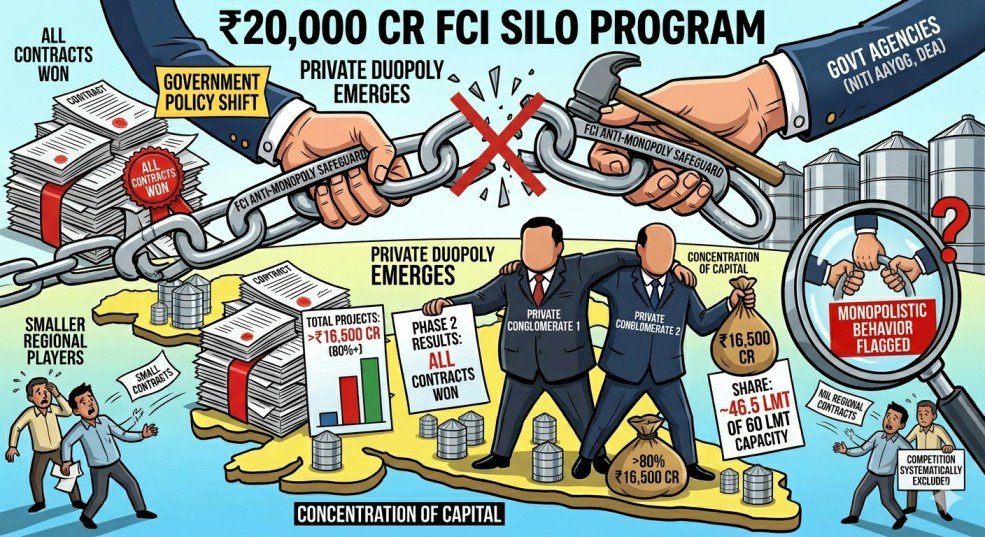
NEW DELHI — A major consolidation has emerged within India’s agricultural logistics infrastructure. Following structural policy modifications that removed internal competitive safeguards, two private entities—Adani Agri Logistics Ltd and Leap India Food & Logistics Private Ltd—have successfully cornered over 80% of the contracts under the Food Corporation of India’s (FCI) mega modern storage modernization program.
The ₹20,000 crore “Hub and Spoke” steel silo project was launched to overhaul how India preserves its public distribution system (PDS) foodgrain stocks. However, recent bidding rounds reveal a massive concentration of public contracts. Out of 134 total silo contracts awarded across the first two execution phases, the Adani-Leap India combine has secured 110 contracts worth over ₹16,500 crore.
The Policy Shift: Dropping the Anti-Monopoly Safeguard
The core of this market concentration stems from a critical regulatory shift in 2022. Recognizing the risk of a single player dominating essential food security infrastructure, the FCI had initially proposed a strict “anti-monopoly” clause within the bidding guidelines. This clause was designed to prevent any single private corporation from cornering bulk project packages across region-wide clusters.
However, during a pivotal structural review meeting in 2022, key central advisory bodies—including NITI Aayog and the Department of Economic Affairs (DEA)—strongly opposed the restriction.
The Regulatory Argument: Central planners argued that caps on bidding capacities artificially stifle market forces. To attract vast private capital quickly and fast-track high-tech infrastructure execution, they advised letting open market competition prevail.
Yielding to this push, the FCI dropped the safeguard entirely. Immediately following the revision, Adani Agri Logistics swept every single contract in the subsequent round of Phase 1. By Phase 2, the open-market strategy culminated in a clear duopoly.
The Allocation Breakdown: Infrastructure & Capacity
The shift away from distributed regional bidding has significantly skewed the ownership of India’s upcoming high-tech food security reserves:
| Attribute | Combined Share (Adani + Leap India) | Remaining Competitors | Total Program Scope |
| Contracts Awarded | 110 Contracts | 24 Contracts | 134 Contracts |
| Financial Value | ~₹16,500 Crore | ~₹3,500 Crore | ~₹20,000 Crore |
| Storage Capacity | 46.5 Lakh Metric Tonnes (LMT) | 13.5 Lakh Metric Tonnes (LMT) | 60 Lakh Metric Tonnes (LMT) |
Of the total ₹16,500 crore duopoly slice, the Adani Group alone locked in a massive ₹9,700 crore worth of contracts during its latest individual battlefield sweep, drastically expanding its nationwide logistical footprint.
Efficiency vs. Market Concentration
The rapid construction of these mechanized steel silos addresses a desperate operational need. Armed with automated temperature and humidity controls, these systems eliminate the massive grain rot, weather damage, and pest infestations common to legacy open-air “Cover and Plinth” (CAP) storage. Furthermore, integrated rail sidings cut farm-to-mandi handling timelines down from days to hours by enabling direct bulk loading onto train rakes.
However, sector watchdogs and fair-trade experts point out that India’s competition regulator, the Competition Commission of India (CCI), routinely flags excessive market concentration and monopolistic patterns as risks to public spending. In this instance, the relaxation of market safeguards by state planning departments themselves has systematically sidelined smaller, regional infrastructure players, leaving the nation’s core food supply chain infrastructure under the control of just two private conglomerates.