

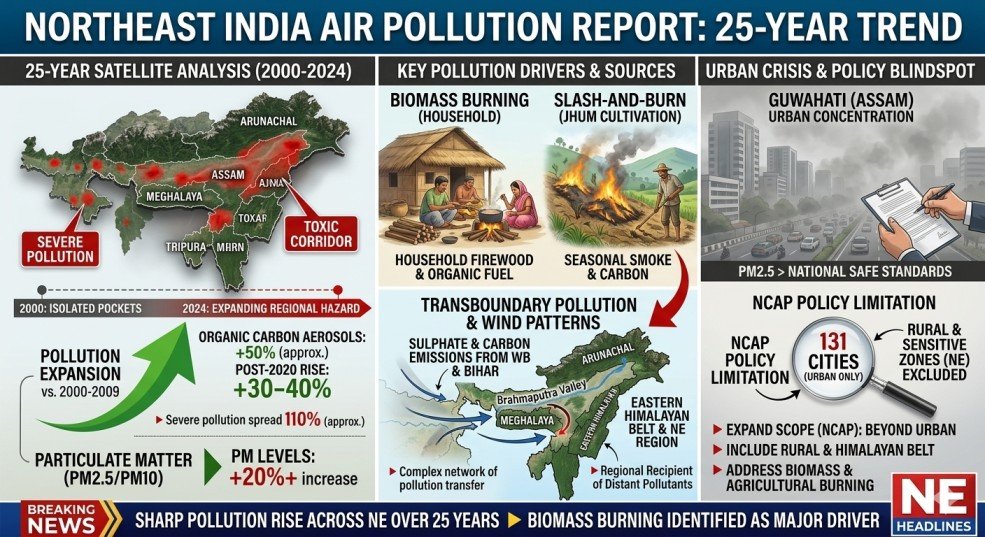
For decades, Northeast India has been celebrated for its pristine landscapes, dense forests, and clean mountain air. However, a groundbreaking 25-year satellite study has shattered this idyllic image. Research led by Abhijit Chatterjee and Soumen Raul from the Bose Institute in Kolkata reveals that air pollution has risen sharply across the region over the past quarter-century.
The study, published in the journal Atmospheric Environment, tracked pollution trends from 2000 to 2024 across the Indo-Gangetic Plain, the Himalayan region, and the Northeast. The findings paint a worrying picture: what used to be a problem confined to major industrialized cities has now transformed into a sprawling, interconnected network of regional pollution.
📈 The Numbers: A Steep Upward Trajectory
The researchers analyzed a massive cache of long-term data and found that pollution levels in the Northeast surged by 20% to nearly 50%, depending on the specific pollutant.
- The Decade Jump (2010–2019): Particulate matter (PM) concentrations during this decade were more than one-fifth (over 20%) higher than what was recorded between 2000 and 2009.
- The Smoke Surge: Organic carbon aerosols—microscopic particles heavily tied to smoke—shot up by almost 50% compared to the first decade of the millennium.
- The Post-2020 Acceleration: Instead of leveling off, carbon-linked pollution accelerated even faster after 2020, climbing an additional 30% to 40% by 2024.
As a result of this compounding growth, massive swathes of the Northeast have officially crossed the threshold into “high pollution” territory.
🗺️ Expanding Borders: From Isolated Pockets to Toxic Corridors
One of the most concerning revelations of the study is how the geography of pollution has expanded.
In the early 2000s, heavy carbon pollution existed only in isolated pockets within Assam, Meghalaya, and Tripura. Over the years, these pockets steadily bled outward, covering larger territories until they eventually fused together. Today, they form a continuous toxic corridor that links directly with the heavily polluted air mass of neighboring Bangladesh and the lower Indo-Gangetic Plain.
While major urban centers like Guwahati recorded PM2.5 levels vastly exceeding national safety standards, the crisis is no longer purely urban. The satellite data shows that pollution has leaked heavily into rural areas and previously untouched valleys on a massive scale.
🪵 The Real Culprits: Why the Northeast is Different
When we think of air pollution in India, we usually picture coal-fired power plants, heavy industries, and bumper-to-bumper city traffic. But the researchers point out that the Northeast faces an entirely different set of challenges:
1. Household Biomass Burning
The single most significant driver of the region’s growing pollution burden is a foundational, everyday necessity: cooking and heating. Millions of rural households still depend heavily on biomass fuels, burning firewood, dung cakes, and other organic matter daily.
2. Intensified Jhum Cultivation
The traditional slash-and-burn farming method, known locally as jhum, has intensified. The widespread, seasonal burning of forests to clear agricultural land sends massive plumes of smoke and carbon-based particulate matter into the atmosphere.
3. The Weather “Trap” and Transboundary Winds
The Northeast acts as both a victim and a creator of pollution. Winds moving through the Brahmaputra Valley act as a geographic conveyor belt, sweeping in sulphate and carbon emissions from neighboring industrial states like West Bengal and Bihar. Additionally, pollution travels back and forth between different Himalayan sectors and the Northeast, turning the entire region into a complex web of pollution transfer.
🚨 The Policy Blindspot: Why Current Programs are Failing
The study delivers a stark critique of India’s current environmental interventions. Right now, the country’s flagship clean-air initiative—the National Clean Air Programme (NCAP)—focuses almost entirely on 131 “non-attainment” cities.
Because current policies are strictly urban-centric, they completely ignore the vast rural expanses where biomass and agricultural burning take place. Consequently, a massive chunk of the Northeast falls entirely outside any active government intervention or air-quality protection program.
📋 The Roadmap: A Call to Protect Ecologically Sensitive Zones
If India continues to ignore rural and ecologically sensitive areas, the study warns that national clean-air policies will fundamentally fail to control a massive portion of the country’s PM pollution.
To fix this, the researchers strongly recommend expanding the scope of the NCAP. They urge policymakers to look beyond city boundaries and immediately include rural zones, the Northeast region, the Himalayan belt, and ecologically fragile biomes like the Sundarbans into the national monitoring and relief framework.