

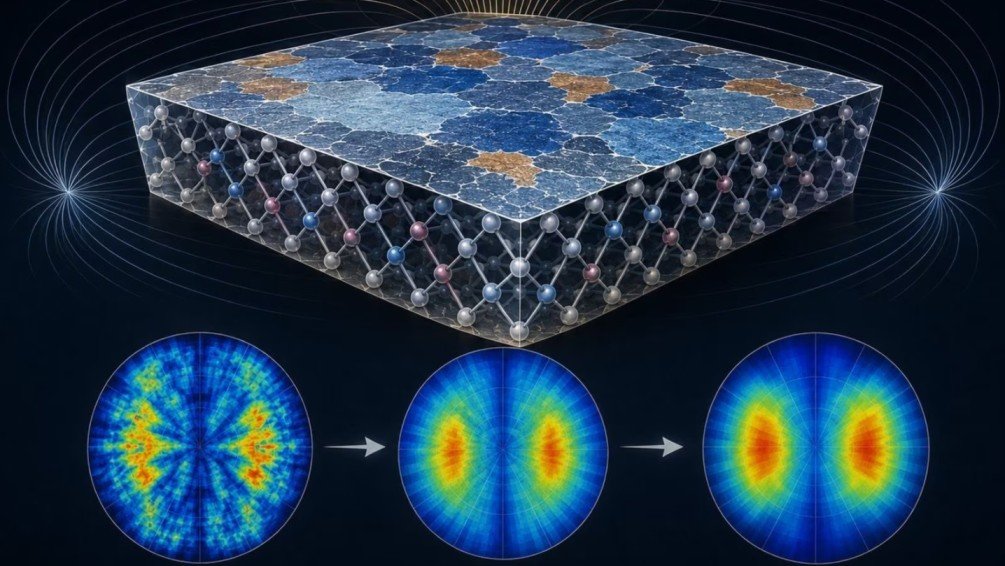
The Holy Grail of Quantum Scalability
In a profound materials science discovery that bridges heavy-duty semiconductor manufacturing with ultra-advanced quantum architecture, researchers have unlocked a method to engineer tunable superconducting pathways directly inside diamonds. The milestone paves a realistic path forward for creating single-die, integrated “quantum-on-chip” systems, solving the notorious scalability and fragile coherence challenges that have bottlenecked commercial quantum computing for a generation.
Diamonds have long been heralded as the ultimate playground for quantum mechanics due to their pristine carbon lattice structures. However, forcing diamond substrates to smoothly interface with delicate superconducting circuits has historically required messy, mixed-material welding that introduces fatal processing defects. This new breakthrough bypasses that barrier entirely by modifying the diamond matrix itself.
THE QUANTUM-ON-CHIP INTEGRATION
Pure Diamond Substrate
Chemically Altered via: Boron Atomatic Doping ]
Yielding: Tunable Superconducting Quantum Circuits ]
The Science: What Boron Doping Changes
At its atomic baseline, an industrial diamond is an exceptional electrical insulator because its electrons are locked tight in dense covalent carbon bonds. To transform this rigid gemstone into an active computing highway, scientists strategically flooded the diamond matrix with boron atoms—a process known in nanotechnology as doping.
Because boron has one less valence electron than carbon, this atomic substitution creates empty electron slots, or “holes,” throughout the crystal lattice. When the material is supercooled down toward absolute zero, these holes form localized electronic pairs that flow with zero friction or resistance.
The true breakthrough, however, lies in tunability:
- The Static Old Method: Once a material was synthesized as a superconductor, its electrical properties remained rigidly locked in place.
- The Tunable New Method: By carefully applying external gate voltages across the boron-doped regions, the research team successfully dialed the superconductivity up, down, or turned it off entirely in real-time. This level of granular control allows developers to manipulate qubits and route quantum information along precise paths within the exact same piece of diamond.
Why a Single-Material System is a Game Changer
Modern quantum computers are monstrously complex assemblies that require linking completely separate components—using diamonds for data storage (quantum memory) while relying on heavy metals like aluminum or niobium for processing loops. These mismatched materials expand and contract differently when supercooled, cracking under physical stress and leaking vital data through quantum decoherence.
By carving both the processing loops and the memory banks out of a single, continuous sheet of boron-doped diamond, engineers can build incredibly robust, microscopic quantum processors. This monolithic architecture shields the system from environmental noise, slashes error correction overheads, and dramatically reduces the scale of the cooling rigs required to keep quantum states stable.
The technology is expected to quickly move out of physics laboratories and into high-tech fabrication foundries, serving as the industrial blueprint for mass-producing quantum microprocessors capable of handling complex cryptographic decryption, advanced materials simulation, and deep-space communications networking.