
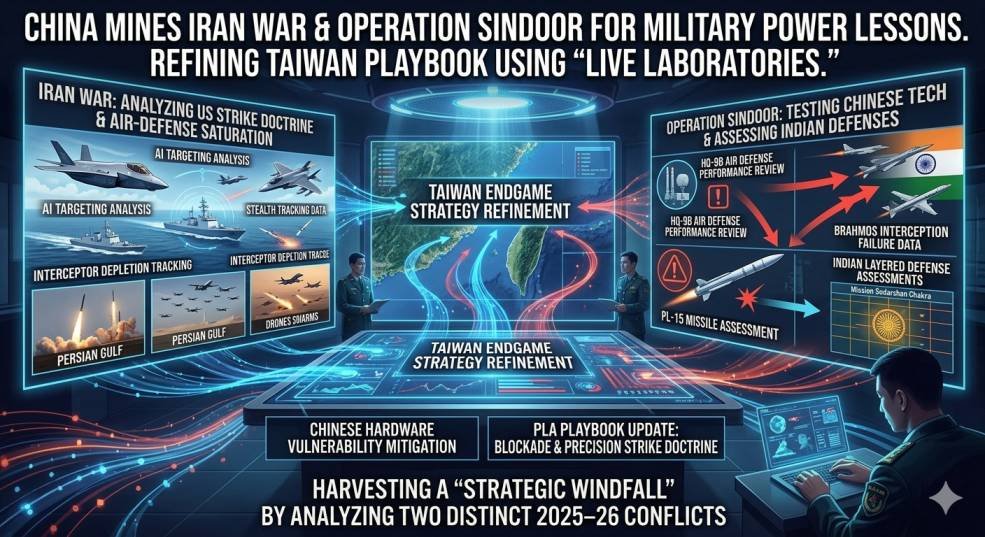
Defense planners in Beijing are reportedly harvesting a “strategic windfall” by analyzing two distinct 2025–26 conflicts: the Iran war and India’s Operation Sindoor. By studying these “live laboratories,” China aims to refine its Taiwan playbook, focusing on U.S. strike capabilities and the vulnerabilities of its own weapons systems in high-intensity combat.
The Iran War: Decoding U.S. Strike Doctrine
In the Middle East, China is leveraging its distance from the front lines to observe the United States at war.
- AI Targeting: Chinese geospatial firms like MizarVision are reportedly using AI to track Western stealth aircraft and naval movements, providing datasets that help Iranian forces refine precision strikes.
- Saturation Warfare: Beijing is meticulously tracking interceptor depletion rates and how U.S. air defenses respond to mass drone and missile salvos—critical data for a potential blockade of Taiwan.
- Energy Chokepoints: Analysts are modeling how quickly energy stress from the Strait of Hormuz blockade translates into industrial disruption, mirroring potential scenarios for Taiwan.
Operation Sindoor: Testing Chinese Tech Against India
Closer to home, Beijing recently admitted that Chinese engineers were on the ground at Pakistani air bases during the May 2025 India-Pakistan conflict (Operation Sindoor).
- Hardware Failures: The conflict exposed significant flaws in Beijing-backed hardware. Pakistan’s Chinese-made HQ-9B air defense system and PL-15 missiles reportedly failed to intercept Indian BrahMos missiles and drones.
- Indian Air Defense: China is closely studying the performance of India’s Integrated Air Command and Control System and the newly announced Mission Sudarshan Chakra, an AI-enabled, layered defense grid.
- Intelligence Shift: Beijing is also analyzing India’s transition to “non-contact war,” characterized by rapid intelligence synthesis and AI-driven targeting.
The Taiwan Endgame
Military experts suggest these observations are being synthesized into a single objective: the Taiwan endgame. While the U.S. remains a powerful adversary, Beijing believes that a better strategy—informed by real-world data on U.S. impulsiveness and hardware limitations—could give the PLA a decisive edge in a lightning strike or total blockade.