
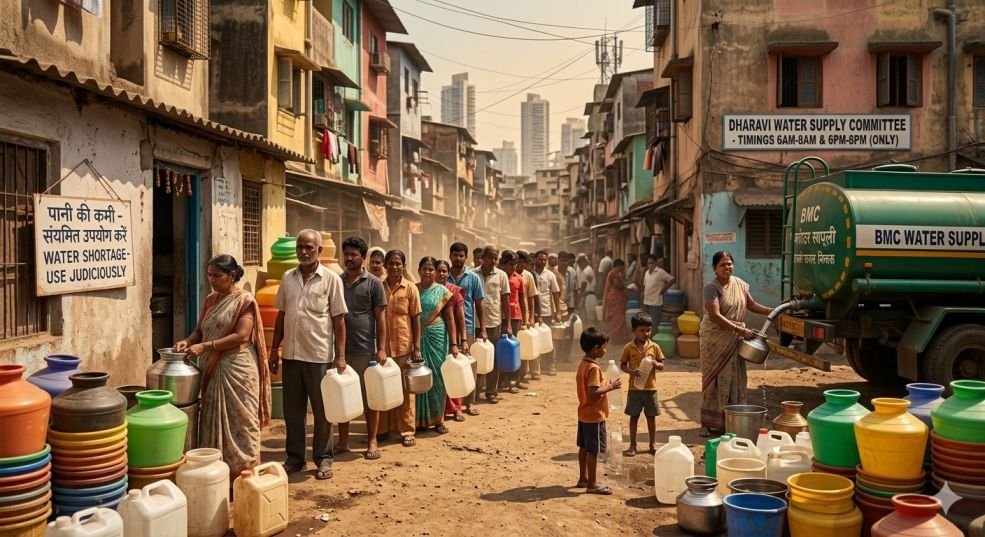
MUMBAI — June 3, 2026 — The Brihanmumbai Municipal Corporation (BMC) has been pushed into emergency planning mode following a downward revision of the monsoon forecast by the India Meteorological Department (IMD). With Mumbai’s key reservoirs holding just enough water to last roughly 45 days, civic officials are scrambling to safeguard the city’s potable water supply through to the summer of 2027.
The 45-Day Reservoir Countdown
Mumbai’s total water reserves across its seven primary lakes have dropped to 15% of their cumulative capacity, translating to roughly 2.21 lakh million litres of water.
- The 3-Day Rule: Within the BMC’s operational framework, each percentage point of lake stock supplies the city for exactly three days.
- Current Timeline: At current consumption levels, the 15% reserve will completely deplete in 45 days unless heavily replenished by seasonal rains.
- Pre-existing Measures: The city is already reeling under a mandatory 10% water cut, which was implemented on May 15 to stretch current reserves.
Why the IMD Forecast Has Triggered Panic
The IMD recently downgraded its southwest monsoon forecast, stating that India is likely to receive only 90% of its Long Period Average (LPA) rainfall. This places the upcoming monsoon season into the “deficient to below-normal” spectrum, raising severe red flags for a city that relies entirely on heavy downpours to fill its dams.
The transition of the El Niño weather system into an active mode over the equatorial Pacific region has further complicated the outlook. Senior civic officials warn that if monsoon catchment rainfall remains deficient, a brutal compounding effect could take hold later in the year. Intense heat waves during October could accelerate lake water evaporation, setting up a highly critical water shortage for the summer of 2027.
Mumbai’s Absolute Reliance on Rainfall
What makes Mumbai particularly vulnerable is its absolute dependency on a healthy monsoon cycle. The city currently possesses no alternative source of potable water supply.
Every single drop of the approximately 3,950 million litres per day (MLD) distributed to households and commercial sectors originates from seven rain-fed lakes:
- Bhatsa
- Upper Vaitarna
- Middle Vaitarna
- Modak Sagar
- Tansa
- Vehar
- Tulsi
These lakes have a combined maximum capacity of 14.47 lakh million litres, which must be fully replenished between June and September to sustain the population until the next year’s monsoon.
The BMC’s Strategy and Contingency Roadmap
In response to the alarming IMD update, senior BMC administration held a closed-door strategy meeting to design an emergency roadmap. The civic body is actively focusing on several immediate and mid-term avenues:
- Intense Catchment Monitoring: Officials have been directed to closely track rainfall data across the seven lake catchment zones over the next two months before making any decision on expanding water cuts.
- Tanker Price and Distribution Regulation: The BMC will aggressively police water tanker filling points across Mumbai. This step aims to guarantee equitable water allocation and stop private operators from price-gouging as demand shoots up.
- Public Awareness Campaigns: The civic body is issuing advisories urging citizens and housing societies to use domestic water strictly and judiciously to avoid unnecessary waste.
- Hoping for Favorable Rain Distribution: Officials note that a deficient monsoon does not automatically guarantee a crisis. If heavy, localized rainfall occurs over the catchment areas during the early months, the reservoirs may still fill to maximum capacity despite an overall lower nationwide average.
While meteorologists stress that monsoon models can evolve as the season progresses, critics and opposition leaders are already highlighting the slow progress of long-term sustainable water infrastructure upgrades in India’s richest civic body. For now, Mumbai remains entirely at the mercy of the skies over the next eight weeks.